



Editor,
Apropos of the editorial “Modi and Manmohan” (ST December 30, 2024) India’s economic growth has seen significant fluctuations over the years, with notable highs and lows. The global financial crisis (GFC) in 2008 and the COVID-19 pandemic in 2020 had substantial impacts on the growth rates. If one assesses whose period was the best growth Manmohan Singh’s or Narendra Modi’s period Both Manmohan Singh and Narendra Modi have had significant impacts on India’s economic growth, but in different ways. The table below speaks for itself.
Gross Domestic Product Growth Rate in India:
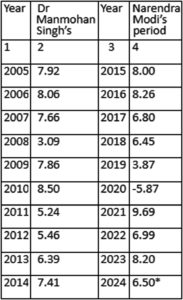
Source: World Bank
*According to the Reserve Bank of India, India’s GDP growth rate for the year 2024-25 is projected to be around 6.5%. This forecast takes into account the recent economic downturn and various factors such as inflation, consumption and global uncertainties.
Manmohan Singh is often credited with initiating the economic liberalization in 1991 at a time when the GDP growth rate was just 1.1% and which went up to 7.5% in 1996, that transformed India’s economy from a closed, socialist system to a more open and market-oriented one. His tenure as Prime Minister from 2004 to 2014 saw consistent economic growth, with significant reforms in various sectors. Singh’s policies helped lift millions out of poverty and positioned India as a rising global economic power. Narendra Modi, on the other hand, has focused on structural reforms and digital transformation. His tenure has seen initiatives like “Make in India,” “Digital India,” and the implementation of the Goods and Services Tax (GST). Modi’s government has also emphasized financial inclusion and infrastructure development. Under his leadership, India has continued to grow, aiming to become a $5 trillion economy. Both leaders have contributed to India’s economic journey in their unique ways. Singh’s era laid the foundation for liberalization and growth, while Modi’s era has focused on modernization and structural reforms. Both Manmohan Singh and Narendra Modi have had significant impacts on India’s economic growth, but in different ways. Both leaders have contributed to India’s economic journey in their unique ways. Singh’s era laid the foundation for liberalization and growth, while Modi’s era has focused on modernization and structural reforms.
I do not agree with the editor that “Modi failed to effect administrative reforms to shake the bureaucracy out of its slumber and corruption.” Prime Minister Narendra Modi’s government has implemented several administrative reforms aimed at improving governance and reducing bureaucratic inefficiencies. Some notable reforms include the scrapping of nearly 2,000 obsolete rules, promoting transparency, and introducing measures to enhance bureaucratic accountability. The government has also focussed on digital reforms and cleanliness as part of its governance initiatives. However, challenges within the Indian Administrative Service (IAS) and the wider bureaucracy persist. Issues such as political interference, lack of specialization, and outdated personnel practices continue to affect the effectiveness of the bureaucracy. While the Modi government has made efforts to address these shortcomings, critics, whom Shakespeare calls “brushmen of noble people,” argue that more comprehensive reforms are needed to fully modernize India’s administrative machinery.
To fully modernize India’s administrative machinery, several comprehensive reforms are needed: Structural reform that empower local governments and decentralized decision making to ensure swift and effective governance. Create autonomous agencies for specific functions to enhance efficiency and accountability. Then there is a need for procedural reforms like streamlining administrative procedures to reduce red tape and improve efficiency. Implement digital solutions to make government services more accessible and transparent. Institutional reforms demand strengthening of institutions so as to enhance their capacity to deliver public services effectively. Establish new regulatory and oversight agencies to ensure accountability and performance. There is also a need for behavioural reforms by providing continuous training and development programs for government employees to improve their skills and attitudes.
Introduction of performance-based incentives to motivate employees and improve service delivery is imperative. Then there is a need for citizen-centric reforms by strengthening mechanisms for addressing public grievances and ensuring timely resolution of public grievances redressal. Promote transparency and accountability in government operations through the Right to Information and other measures. Legal reforms call for reviewing and updating outdated laws to reflect current realities and needs. Then there is need to improve the efficiency of the judicial system to ensure timely justice. Technological reforms call for investment in digital infrastructure to support e-governance initiatives and for data driven decision making. Utilizing data analytics to inform policy decisions and improve governance is another key area. These reforms aim to create a more efficient, transparent, and responsive administrative system that can effectively meet the needs of India’s diverse population.
Yours etc;
VK Lyngdoh,
Via email
A call to reform our politics
Editor,
As we come to the close of 2024, I was fortunate to have had the chance of attending the programme organised by Sein Raij Shillong on December 30, 2024 as we commemorated the 162nd Death Anniversary of U Woh Kiang Nangbah. Dignitaries including Habapan Sing Syiem, Syiem Khynnah of Hima Khyriem and Dr HH Mohrmen who graced the occasion as the Chief Guest and the Guest of Honour spelled out the sacrifice and the willingness of the martyr to fight for his land and people 162 years ago.
As I listened to the speakers and sat looking at the flex that had the image of U Kiang Nangbah, words that resonated in my mind were leader, courage, betrayal. Dr Mohrmen spoke about what lessons we could learn from a legend like U Kiang Nangbah? Amongst the various lessons, I find this lesson that says each one of us have something to offer to have a very deep meaning. U Kiang Nangbah offered his leadership and courage for the sake of his people and the love that he had for his land and country.
Come the new year, what do we have to offer to our land, our people and humankind in this wide world? As individuals we work towards the betterment of our lives at a personal level but can we be selfless and more compassionate? Can we start thinking beyond ourselves? Can we offer a helping hand to those who are in need? Can we become less corrupt? Can we have leaders of the likes of U Kiang Nangbah, U Tirot Sing Syiem and Pa Togan Sangma? Representatives we sure do have as we voted for them but once in power our representatives no longer represent our cause but simply theirs!
We people are made to take a back seat to the point of neglect and oblivion. This is nothing but betrayal of the common people’s hopes and expectations. The saying – Promises are made to be broken holds true with our representatives. Tall claims made are seldom fulfilled. This calls for courage of a different kind; one bereft of conscience, ethics and morality. To cheat, to loot, to plunder, to swindle must not become a way of life but surely these are qualities that can be found in abundance.
However, keeping spirits high and bright, I still have a lot of faith in each one of us and look forward to a year filled with positivity and righteousness. Can we? We sure can!
Yours etc.,
Jenniefer Dkhar,
Via email
