



In Conversation with Francesc Miralles at The Shillong Literary Festival, Sanjay Kar rediscovers the meaning of life beyond the mundane.
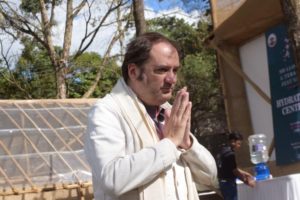
 From the sun-drenched hills of Priorat in the Catalonian region of Spain, comes Francesc Miralles (FM), a man who dons many hats. He is a journalist, author, translator, and therapist, all rolled into one.
Forming the core of his life is ikigai, a beautiful Japanese concept that roughly translates to “a reason for being” or “the reason you wake up in the morning.”
The word is made of two parts: “iki” which means life or to live and “gai” meaning value or worth.
co-authored the book with Hector Garcia, Miralles excellently portrays the Japanese concept in his 2016 bestseller IKIGAI The Japanese Secret to a Long and Happy Life.
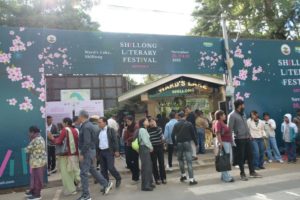
Miralles, who was here earlier this week to attend the Shillong Literary Festival 2025, took time out of his busy schedule for an interview with Sunday Shillong.
Excerpts:
SS: You’ve worked as a journalist, a translator, editor, art therapist, and now you are a full-time writer. So, how did these different roles shape you up?
FM: I think I am still a journalist because I write for newspapers, I write for magazines, and I am a lecturer. There are writers that only write, some of them are professors. And in every profession, you learn new things because you know new people. So, I am happy to be in different professions because then I have different influences, and I don’t like the idea of the writer that is isolated all day thinking and writing. I think that ideas come from people and I like to be in community.
 SS: You grew up in Barcelona. You were educated in a Catholic school. So, how did that early environment shape you into what you are today?
FM: When I was a child, we were under the dictatorship of Franco. You went to a school of only men, going to the church every week, even if you were not feeling Christian or something like that. And with a very narrow state of mind in this education. Then democracy came in the 70s, and we discovered that the world was wider. So, I have had many different periods in my life. Music, for instance, was always a big influence for me – pop music, rock music, punk music, playing music with other people, and of course also studying German literature.
SS: You have often described ikigai as a reason to live or a reason to get up in the morning. How has your own ikigai evolved over time?
FM: I think I am in my fourth ikigai nowadays. My first ikigai was being a German language teacher. But it lasted only two, three years because I didn’t like repetition. My second ikigai was being a publisher. There were three, four years in which I was working in a publishing house. My third ikigai was as a writer and I would say that nowadays writing is not what I do more often. At present, I am more of a lecturer, a speaker than a writer. So, I am in my fourth ikigai: sharing wisdom with people everywhere I go and helping other people to find their ikigai.
 SS: Many of your readers admit that they often lean towards ikigai in their moment of crisis. Is that a truth or a misunderstanding?
FM: There are three moments in life where ikigai is important. Once, when you are a teenager and you have to decide if you want to do this education or another, go to college, stay here, go to the big city. The second moment in which ikigai is important is when you retire. Then, you must reinvent your life and you think what am I going to do with my time, my life? Then you find your ikigai again. And the other is in times of crisis. If you have an illness, if you get divorced, if you suffer an economic failure, then you must start from zero, from scratch. And that’s where ikigai is important to find a new purpose in life.
SS: If you meet someone who seems to be lost, what advice would you give them to find their ikigai?
 FM: My advice would be to disconnect from social media. There are people who are lost, who are bored, but they are scrolling all day. And this is a mechanical way of thinking. So, what you need to do is get out of your house, get out of your phone, talk with people, go to a lecture, go to some other place, talk to your neighbours and then in this way maybe something new is going to wake you up.
SS: A message from you for the people of Shillong?
FM: To the people of Shillong, I would say they live in a very beautiful place. This is a treasure that you must keep and that you must show to the world because I had never heard about Shillong and I think if they show it properly, many people from Spain, from Japan, from other places will be interested in coming here and it would be good for the economy and for the self-esteem of the population.
—End of Interview—
