


By Aquiny Befairlyne T Mawthoh
Valentine’s Day is around the corner, and as people prepare to celebrate love with their loved ones with colourful flowers, thoughtful gifts, chocolates, and handwritten notes, the natural world is quietly busy with its own beautiful expressions of romance. Insects, on the other hand, are often overlooked or misunderstood, yet their stories of love are far from simple. Courtship in the insect world is an intricate and fascinating process, shaped by millions of years of evolution. Insects communicate love through light, sound, scent, and movement , and sometimes even acts of sacrifice. Each signal carries a message, and every choice matters . These small creatures tell big stories of connection, reminding us that love exists everywhere around us, quietly influencing life beyond what we usually notice.
 For many insects, love begins with scent. Invisible to us, pheromones act as powerful chemical messages that drift through the air, guiding potential partners toward one another. Moths and butterflies are masters of this form of communication. Females release sex pheromones from their abdomen, sending a signal that can travel astonishing distances. A male, picking up even the faintest trace, follows the invisible trail with precision until he finally reaches her (‘Pheromone communication in moths: evolution, behavior, and application’ Allison 2016). In a vast world, scent becomes their way of finding ‘the one’. In some species, courtship becomes an art form and no insect demonstrates this better than the orchid bee. Male orchid bees spend their entire lives collecting scents, not just from orchids but from many different sources in the environment. Over time, they create a unique fragrance blend made up of 20 to 40 chemical compounds. These scents are carefully stored in special pockets on their hind legs. When the time comes to impress a female, the male releases his signature perfume. Surprisingly, these blends may include floral notes as well as strong odours from unexpected sources, even animal droppings (Henske ‘Function of environment-derived male perfumes in orchid bees’ 2023). To a female orchid bee, this scent tells a story of effort, experience, and dedication. If she chooses him, she mates only once, forming a lifelong bond. In the insect world, this is love at its most exclusive.
 While some insects speak through scent, others shine. For fireflies, light is more than just a glow, it’s a language of love. Male fireflies send out flashes of light that act like a personal introduction: they tell females what species they belong to and that they are ready to mate. Each species has its own flashing pattern, and females respond only to the correct signals. Some females, like those of the Big Dipper firefly, prefer longer flashes, while others are attracted to faster flashing males. The courtship is a careful, sometimes lengthy dance. Females often play hard to get, replying to only every fifth flash. This means that even if a male and female are sitting on the same blade of grass, they can spend hours exchanging flashes before connecting (Genetic Science Learning Center, 2017) . Once a pair finds each other, they mate tail-to-tail, with the male blocking rivals for the night.
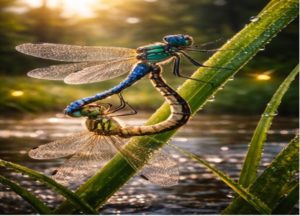
Dragonfly love is fast, intense, and anything but gentle. With their sharp eyesight, males scan ponds and lakes for the right female, recognising her by subtle details in her size, colour, and flight. There is no long courtship, once he chooses, the male grips the female firmly and they fly together in tandem, locked in motion. After preparing himself, the pair twist into the famous wheel formation, their bodies curving into a perfect circle as mating takes place, sometimes in midair, sometimes on a quiet perch (Hadley, May 8, 2025). What may look rough or chaotic is actually a carefully evolved dance of strength, flexibility, and choice, reminding us that in nature, love doesn’t always whisper; it sometimes spins boldly through the sky.
 As daylight fades, sound takes over. What we often dismiss as night time noise, the chirping, buzzing, and humming is actually one of nature’s most active dating scenes. Hidden among grasses and trees, insects such as crickets, katydids, grasshoppers, and cicadas fill the air with carefully crafted calls. These sounds announce their presence, signal their fitness, and help females decide who is worth choosing. Crickets, for example, use two different songs. The first is the calling song, a steady and consistent tune meant to attract females from a distance and confirm species identity. Once a female comes close, the male switches to a courtship song softer, more varied, and more personal. This intimate sound gives the female clues about his strength and health (‘Field crickets change mating preferences using remembered social information’ Bailey 2009).
Love, even here, is about listening closely. Cicadas take this conversation a step further. Females actively participate by responding to a male’s loud call with a brief clicking or snapping sound. This simple signal tells the male she is interested. He follows the sound, finds her, and mating begins (The best of both worlds, Hou 2022). Interestingly, humans can sometimes mimic this signal snapping fingers can actually attract male cicadas, who mistake it for a receptive female’s reply.
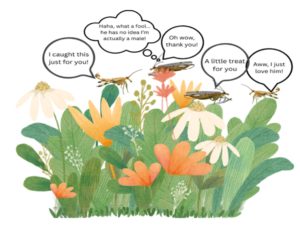
Not all courtship is about signals alone. In scorpion flies, love comes with a gift. Males often present females with captured prey during mating, allowing her to feed while copulation takes place. But not every male is a skilled hunter. Some take a more cunning approach. These males mimic the appearance and behaviour of females, tricking other males into offering them food. Once the prey is presented, the impostor escapes with it and later uses the stolen gift to impress a real female(Engqvist 2007). Surprisingly, this strategy often leads to greater mating success. Nature reminds us that love is not always fair or perfect, it can be clever, complicated, and flawed.
Katydids offer another touching example. Hidden among leaves, a male announces himself with a rhythmic song produced by rubbing his wings together. To human ears, it’s background music. To a female, it’s a message filled with meaning: his species, his strength, and his readiness to mate. As she approaches, he softens his song and carefully positions himself beside her. When mating occurs, the male gives more than sperm. He offers a nutrient-rich package called a spermatophore, part of which the female eats while fertilisation takes place. This gift nourishes her and increases the male’s chances of reproductive success. Female katydids are selective, preferring males who offer larger, well-developed gifts(Gwynne 1982). Love here is measured not by words, but by what one is willing to give.
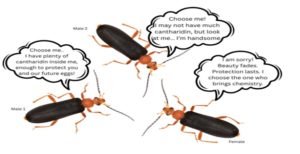 In some insects, chemistry quite literally defines romance. Certain beetles produce a defensive chemical called cantharidin. In Neopyrochroa flabellata, this chemical is central to courtship. Males collect cantharidin, sometimes accumulating amounts that make up nearly one percent of their body weight. Females inspect potential mates based on how much of this substance they possess. If a male has too little, he is rejected. If accepted, he transfers the chemical to the female, who uses it for her own protection and saves some for her eggs(Eisner 1996). Effort and responsibility, once again, shape attraction.
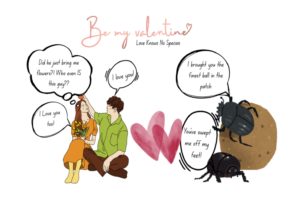
Then there are dung beetles, whose love stories are as unusual as they are practical. Instead of songs or scents, males offer balls of dung as nuptial gifts. These carefully shaped dung balls provide essential nutrients for egg development. A female chooses the best one, often climbing on top to show her interest. Rival males may try to steal both the ball and the female, forcing the male to defend his prize. Once successful, the pair bury the dung ball together, mate, and the female lays her eggs inside, giving her offspring a safe and nourishing start(Castro,2014).
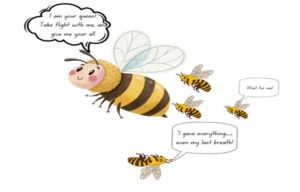
Perhaps the most dramatic love story belongs to bees. Queen bees mate only once in their lifetime during a breathtaking nuptial flight. As she flies, she releases pheromones that attract drones from many colonies. She mates with several males mid-air, storing their sperm for the rest of her life. For the drones, this act is final after mating, they die(Vegas bees, 2023). Love here comes at the ultimate cost.
 Even the ordinary house fly has a small but carefully choreographed love story. When a male spots a female, he wastes no time. With a quick jump or short flight, he lands on her back and begins to vibrate his wings, sending out a steady signal of interest. The female responds by stretching her wings outward and lifting her hind legs, acknowledging his presence. Slowly, the male moves forward, sometimes tilting his head or extending his mouthparts, as if testing her reaction. He then reaches out with his front legs, lightly moving the female’s legs up and down, gauging whether she is receptive. Only after this brief exchange does he move backward and attempt to mate(Colwell 1975). Though it lasts just moments, this interaction follows a precise sequence, reminding us that even the smallest and most familiar insects follow their own quiet rituals of courtship.
When we think of love, we often imagine grand gestures, flowers, gifts, and words spoken from the heart. But step outside for a moment, and you’ll find that love has been quietly unfolding all around us for millions of years. In the insect world, romance takes many forms as discussed above. These tiny creatures remind us that love is not always loud or obvious, but it is always meaningful. Insects don’t fall in love with poetry or promises. Their courtship is about trust, effort, and giving something of value whether it’s protection, nourishment, or a safe future for the next generation. In that way, their stories feel surprisingly familiar. Just like humans, they choose partners carefully, respond to care and commitment, and understand that love often asks for patience and contribution.
This Valentine’s season, as we celebrate love in our own ways, the natural world gently reminds us that love is older than us, wiser than us, and far more diverse than we imagine. Sometimes, the smallest creatures tell the biggest love stories, if only we take the time to listen.
Source of Images – Author



