




By Dr. Amanda Christie Tongper
(From the Book of Exodus, Deliverance: A Musical was performed on the 28th of February, 2026 by the Jaiaw Presbyterian Church at the Soso Tham Auditorium, Shillong. The play tells the Biblical story of God’s deliverance of His people from the bondage of Pharaoh’s Egypt.)
When I was ten years old, my mother took me to watch a play at Jowai’s beloved and iconic Tympang Club. The play was an adaptation of the story of Saul of Tarsus and his transformation into Paul the Apostle on the road to Damascus. In the Biblical story, Saul had persecuted Christians before his conversion, so when he later returned as Paul, the early Christians were understandably afraid of him.
I remember one moment with unusual clarity. The stage curtains had been drawn and the audience sat waiting for the next scene. Suddenly there was a loud commotion from behind the curtains. Women were shrieking in fear. There were sounds of confusion and struggle that we could hear but not see. The cries were so convincing that the audience rose from their seats and rushed toward the door. For a brief moment there was chaos in the hall.
Then the curtains opened.
What I saw next has stayed with me all my life. Standing on stage was Paul. With impeccable improvisation, the actor reached out toward the audience and called out to us repeatedly, “Do not be afraid. I am Paul, not Saul.” The moment was moving as it was terrifying. Paul, the actor, did not break character. Slowly, in a state of confusion and half belief, the audience returned to their seats. Once calm was restored, he continued with his lines which I have long since forgotten. What I have never forgotten is the thrill of that moment.
 As a ten year old, I remember insisting to the adults around me that the actors had done it on purpose. They had frightened us deliberately so that we, the audience, briefly became part of the performance ourselves. Only much later did I realise what I had witnessed. It was theatre at its most powerful, a moment in which the fourth wall dissolved and the audience was pulled into the emotional world of the play.
Looking back now, it feels like a perfect illustration of what Aristotle meant when he spoke about the evocation of pity and fear. In one brilliant moment, the director had managed to provoke both.
I did not think I would experience something like that again.
Until Deliverance.
I am certain it was not the intention of the musical to begin much before the actual performance, yet in my mind the setting of the play seemed to start outside the hall itself. The pastoral atmosphere was already present in the bleating of kids (goat-kids, to be precise), patiently waiting for show-time. Their sounds drifted through the evening air as the audience gathered, almost as though the world of the play had begun forming long before the curtains were drawn.
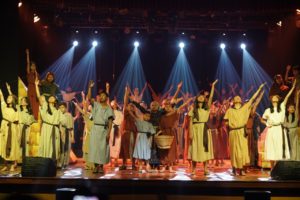
Inside the hall, everything began on the dot. A hushed audience settled into silence and soon found itself witnessing the impressive sight of a deeply committed ensemble of actors. The cast ranged from toddlers to adults, from pre-school children to what appeared to be retirees. Watching them assemble on stage, my first thought was that the majesty of the performance lay not only in its artistic vision but also in the sheer scale of its organisation.
Managing such a production is no small feat. Behind the scenes there must have been a delicate choreography of schedules and responsibilities that must have gone on for months. There were goat-kids, school-kids, college students, working adults and many others whose commitments I would not even dare speculate. Yet somehow they all came together in a performance that felt both seamless and assured.
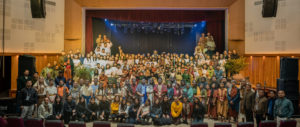
If my article were to end here, I would simply say that the musical was already a success for this reason alone. To bring one hundred and seventy actors and volunteers onto the stage, more than once during the performance, without a visible misstep is an achievement in itself.
 There is much to be said about the character of Moses, played by Dion Trevor Marwein. His musical prowess is surpassed only by the thunderous authority of his voice as he calls a chosen people out from the shackles of Pharaoh’s Egypt. While the character of Moses delicately leads even as he pleads, rising with the authority of a leader yet humbling himself as a servant, the character of Ramses, played by Bariminot Sun, remains resolutely villainous for most of the play. He is loud, unyielding and consumed by anger until the moment he is finally broken by the death of his son (played beautifully by Elhanan Kurbah). In that moment something extraordinary happens on stage. When Ramses collapses into grief, the hall seems to hold its breath. It is not merely Ramses who breaks. The audience breaks with him. I hope someone has told Bariminot Sun that the sorrow he portrayed travelled far beyond the stage and reached every seat in the hall. Such a moment is born partly from ingenious stage design, but even more from the rare power of an actor who seems almost anointed for the role. A similar vein of power-packed performance ran through the entire cast. Each actor brought a sincerity to the stage that made the world of the play feel alive and inhabited. I wish space allowed me to dwell on every individual performance because many moments of brilliance appeared and disappeared across the stage in quick succession. The strength of Deliverance lies not only in its central characters but in the remarkable talent of the entire ensemble.
The story portrayed in the musical spans several decades, from the infancy of Moses to his emergence as the leader of his people. Such a sweeping narrative always risks feeling compressed and/or truncated when brought to the stage. Yet this potential difficulty was gracefully overcome by the orchestrations led by Damenshan G. Hynniewta, Zediah M. Hynniewta and Dion T. Marwein, whose musical direction carried the audience smoothly through the passage of time.The narrators, Baiarjingmut Kharbuli, Idapalei Shisha Tham, Nainesabet Hynniewta and Kerme-o P. Nongphlang, served as the quiet custodians of the story. Their narrations guided the audience across the changing landscapes of the play, weaving together moments that spanned years and ensuring that the narrative moved forward with clarity and grace.
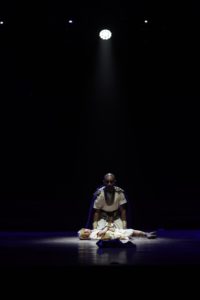 The stage design deserves special mention for the remarkable balance it achieved between restraint and spectacle. At first glance the set appeared almost minimal, yet moment after moment revealed how imaginatively the space had been conceived. From the burning bush to the looming presence of the pyramids, the production created entire landscapes with a striking economy of stage elements. What might have required elaborate scenery was instead achieved through movement, colour and light. The rivers, for instance, were not represented by physical water but by an ensemble of dancers whose choreography transformed the stage into flowing currents. At one moment they ushered in death clothed in black, at another they became waters robed in white. Through these shifting colours and formations, the stage seemed to breathe with symbolic life.
One particularly memorable moment came during the scene in which Aaron’s staff is turned into a snake. The effect was executed with such precision through lighting and carefully handled props that the transformation unfolded almost magically before the audience’s eyes. It is in moments like these that the intelligence of the stage design becomes most evident. Rather than overwhelming the audience with elaborate sets, the production trusted the language of theatre itself, using light, movement and colour to conjure an entire world.
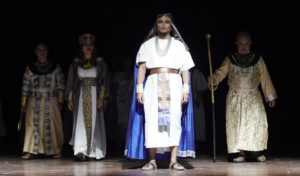
If the stage design created the world of the play, the costumes gave that world its texture and historical depth. The costumes in the production are truly a sight to behold. Carefully conceived and historically attentive, they reflect a remarkable level of thought and precision. Each garment seems to situate the characters firmly within their time, while also contributing to the visual richness of the stage. Perhaps the overall success of the play can be measured by the fact that the only criticism that surfaced, during our full review of the evening on the drive home, came from my niece. She belongs to that age group of critics one does not particularly wish to hear from. Her verdict was brief and devastating: “Moses’ wig was not giving.”
 As the musical drew to a close and the ensemble of actors, singers, volunteers and dancers took their final bow, I found myself deeply moved by the perseverance of Damenshan G. Hynniewta, who stands at the very heart of this production as its director. The success of Deliverance undoubtedly belongs to the entire ensemble, yet credit must also be given where it is due.
What Damenshan has accomplished goes far beyond staging a musical. By bringing together the many children who form such a vibrant part of this ensemble, he has offered them something far more enduring than a performance. In the process of rehearsing and performing together, they have witnessed what harmony, cooperation, grace and kindness can look like when they are practiced every day. In a world that so often presents impressionable young people with images of division and fragmentation, such lessons are powerful. The values these children have experienced through this production may well remain with them for a lifetime.
And if you are wondering, yes, the goat-kids whose bleating had earlier set the tone outside the hall found their brief yet shining moment upon the stage, completing the pastoral atmosphere the production sought to evoke. In that small and almost whimsical moment, the boundary between the world outside the theatre and the world within it seemed to disappear. Perhaps that is the miracle of theatre. It gathers everything into its fold. Children, youngsters and adults from the Presbyterian Church of Jaiaw stood on stage, but the spirit of the production extended beyond it. Students from NIFT Shillong and many others who lent their hands to costume design, lighting, sound, photography and videography were also part of this collective effort.
In that gathering, the message of Deliverance reveals itself not only in the ancient Biblical story unfolding on stage, but also in the harmony the production so beautifully celebrates. No review can quite capture the spirit of what unfolded that evening. Deliverance is, without question, one for the books.
(The author is an Assistant Professor, Department of English, St. Anthony’s College, Shillong)
Photographs by Mebanjop M. Marweiñ

