




Guwahati, March 31: Premier research-driven and community-focused biodiversity conservation organisation Aaranyak, in collaboration with local communities and with support from SBI Foundation (SBIF), as part of persistent endeavour to mitigate human elephant conflict (HEC) and facilitate co-existence have installed solar street lights in certain HEC-prone villages and conducted community awareness of how to coexist with wild elephants roaming in the proximity.
As such, five solar street lights were installed March 23 last in a few human elephant conflict (HEC)-prone villages in Baksa, Tamulpur, and Udalguri districts of Assam to enhance safety of villagers at night by reducing risks associated with HEC.
The installations were carried out in Simlabasti and Belguri (Baksa), Jharbari (Tamulpur), and Uttar Garuajhar (Udalguri)-villages situated along active elephant movement routes, where poor visibility often heightens the risk of unexpected encounters during the night.
The solar lights were strategically placed at high-risk locations, including key approach roads, pathways to agricultural fields, sharp bends, and common community spaces-areas frequently used during early morning and evening hours when visibility is low and vulnerability is high.
Improved lighting has significantly enhanced night-time safety, enabling villagers to better navigate their surroundings, detect elephant presence, and avoid sudden encounters. Beyond reducing immediate risks, the intervention also fosters a stronger sense of confidence and preparedness within the community.
The benefits extend further into daily life-supporting safer movement for residents, easing routine activities after dark, and enabling local volunteers to coordinate more effectively during elephant movement. In doing so, the initiative not only addresses safety concerns but also contributes to building conditions for more secure and sustainable coexistence.
The installations were carried out with active support from Elephant Conservation Network (ECN) members, local communities, and Forest Department officials, under the coordination of Aaranyak’s team.
With the same purpose, Aaranyak-SBIF conducted a few community outreach programmes to educate HEC- hit villagers on way to coexist with wild elephants roaming around in their areas. These outreach programmes organosed during March 22-29 used tools such at storey telling, documentary screenings across a few villages in Udalguri and Tamulpur districts. As part of the continued efforts, sessions were held on March 22 at Nonaikhuti (Udalguri) and in Dhipa and Gerua Gorkhali Chubba (Tamulpur).
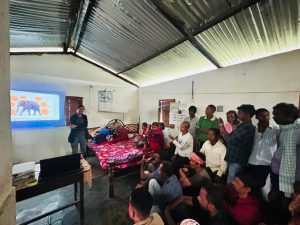
Community members were engaged in interactive discussions featuring Gajah Katha, our signature storytelling approach to understanding elephant behaviour and the drivers of conflict. These sessions combined practical mitigation strategies with open dialogue, where villagers shared real experiences of crop loss, elephant movement, and safety concerns.
Further engagement at No. 1 Kalipur on March 25 emphasized early warning systems, safety measures, and the importance of community coordination. The discussions highlighted how timely communication and collective preparedness can significantly reduce conflict risks.
As part of the initiative, documentary screenings of ‘The Elephant Whisperers’ were held on March 23 at Kalahandi and on March 29 at No. 1 Amjuli (Udalguri). These screenings created an emotional connection with the issue, encouraging reflection on coexistence, followed by conversations on practical solutions.
Across all locations, community members actively participated, exchanging knowledge and identifying locally relevant strategies. In total, 182 participants attended the programmes.

