




Dr. Roy Moodley, professor of Applied Psychology and Human Development at the University of Toronto, Canada, spent a week in Shillong engaging with faculty, counsellors and students. He visited sites of Khasi folktales and spent time with a traditional healer in Nongpoh. Roy is the author or editor of 23 books on cultural psychology, and is a well-known activist for the decolonisation of counselling and psychotherapy.
By Phindaribha Kshir
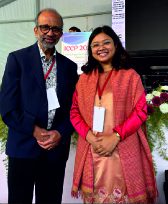
Dr. Roy’s journey to Shillong began not with a plan, but with a moment- an unassuming conversation at the 6th International Conference on Counseling and Psychotherapy in Bengaluru in January 2026. It was there, amid academic discussions and formal exchanges, that his attention was drawn to something deeply personal: the dhara I wore during my presentation on the Khasi matrilineal system. What started as a simple question soon unfolded into something far more meaningful.
He chose to stay back for the session, listening intently, and when it concluded, approached me with a mix of wonder and warmth. There was a spark of genuine curiosity in his questions- about where I came from, about a society where lineage flows through women, and about the quiet strength of traditions that continue to shape our lives. In that moment, it felt as though the distance between two very different worlds had gently dissolved.
What followed was not just intellectual interest, but an emotional connection to a culture he was only beginning to understand. His curiosity deepened into a sincere desire to see, feel, and experience this way of life firsthand. And so, what began as a fleeting exchange in a conference hall led him to Shillong- to our home, our people, and our stories.
Folktale excursion
Dr. Roy’s agenda for the day was simple on paper but rich in promise- to journey into Sohra and experience two of its most evocative heritage sites, Nohkalikai Falls and Dain Thlen, each deeply entwined with the region’s folktales. What unfolded, however, was far more than a scheduled excursion; it became a day shaped by anticipation, wonder, and quiet emotional resonance.
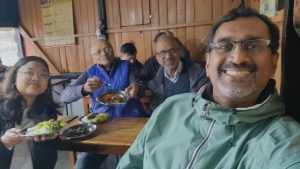
We set out from Mylliem with full stomachs and fuller hearts, the lingering warmth of ja iing carrying us forward. The road to Sohra wound through a landscape wrapped in mist and melancholy skies, yet there was something comforting about the gloom- it seemed to belong to the stories we were about to encounter.
At Dain Thlen, after a steady climb to the top, I found myself opening Kynpham Sing Nongkynrih’s book “Around the Hearth”. As I began reading “The Man-Eating Serpent: U Thlen,” the lines between story and setting blurred. The wind, the silence, the sheer drop of the falls- all seemed to echo the tale’s mystery and tension. It was a rare and almost uncanny feeling, as though the land itself was listening along. In that moment, the folklore was no longer distant or abstract; it felt alive, breathing through the landscape.
That sense of connection lingered as we moved on to Rangjyrteh, Likai’s village. But just as we began to settle into the space, the skies opened up in a sudden, relentless downpour, urging us onward. There was a quiet disappointment in leaving too soon, but also a growing anticipation to reach our final destination- Nohkalikai Falls.
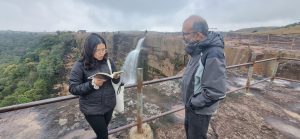
When we arrived, however, nature had other plans. The falls were completely hidden behind a dense veil of fog. We stood there, staring into a blank expanse, expectation slowly turning into frustration. My mentor gently suggested we retreat for lunch and return later, but something within me resisted. Perhaps it was stubbornness, or perhaps it was hope- but I felt certain the mist would lift. I asked for just a few more minutes.
And then, almost imperceptibly at first, the fog began to shift. What seemed like wishful thinking soon became undeniable. The curtain slowly parted, revealing the majestic plunge of Nohkalikai Falls in all its haunting beauty. Excitement rippled through the group, disbelief giving way to awe. In that fleeting window of clarity, I once again turned to the book and read the legend tied to the falls. This time, the experience was not just immersive- it was deeply moving.
Standing there, with the story unfolding against its own living backdrop, it felt as though time had paused to grant us a rare privilege. The disappointment, the waiting, the quiet insistence-it all led to that single, unforgettable moment. And in hindsight, it was not just the highlight of the trip, but a reminder of how patience, belief, and a touch of serendipity can transform a journey into something truly extraordinary.
Meeting a traditional healer
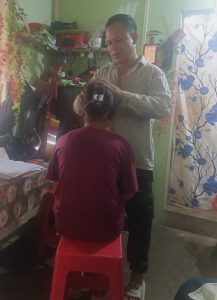
In the middle of the week, Roy spent a few hours with a traditional healer in Nongpoh, Bah Jasper Manih. Roy spoke of his impressions of this meeting. “I thought that we would arrive at some forest to see a healer, sitting cross-legged around the fire, or in the bush collecting herbs. But what we saw was a healer in a clinic in a building, just like allopathic clinics, with outpatients sitting there waiting for their appointments. The healer graciously took us into his office and shared so many things, starting with why he became a healer, and how he learned from his father and grandfather. He explained what he understood about herbal medicine, how he related to patients who were unwell.”
According to Roy, “There is a place for traditional healers as alternative practitioners, working alongside allopathic medicines and also challenging allopathic medicine. I think Western medicine has limitations. It has weaknesses, and while it is clouded under a scientific way of understanding of the mind and the body, it doesn’t deal with certain aspects of human existence, like the spirit. I think traditional healers attempt to understand the body, mind and spirit in a holistic way. This healer provided so many interesting examples of how he does that, and that was very impressive for me.”
Mid-week reflections
Later in the week, Roy spent an evening at my home and over putharo, pusaw and jashawlia, shared his impressions of Shillong, “There have been many, many memorable moments and lots of surprises. This is the first time I’ve come to northeast India. While traveling through the winding roads, and looking at the mountains, I thought, this is God’s own country. The people impressed me; I’ve never seen such a mixture of diversity anywhere else in the world.”
Roy went on to share that he was born in South Africa, lived in England, and currently resides in Toronto, but Shillong far supersedes the multiculturalism he’s seen elsewhere. He says, “It’s very different here, the way people look, the way they dress, the way they talk. Such an interesting experience for me. The landscape of valleys and mountains appear to be not spaces of exclusion or confinement, but bridges of connection with each other.”
Body mapping
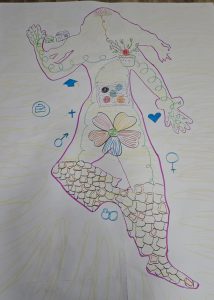
On March 26, Dr. Roy introduced faculty members at MLCU to his workshop, “Body Mapping ”offering an insightful exploration into a therapeutic technique rooted in trauma-informed care. What began as a structured academic session soon evolved into a deeply personal and reflective experience for all involved.
The workshop opened with an introduction to body mapping as a powerful tool in counseling practice- one that allows individuals to visually express emotions, memories, and lived experiences. However, the emphasis was not merely on theory; the goal was to immerse participants in the process itself.
Over the next two hours, the room transformed into a quiet yet powerful space of introspection. What emerged on paper were not just drawings, but deeply personal narratives- stories of resilience, vulnerability, and identity. When the time came to share, participants moved around the room, engaging with each other’s work. The exchange was marked by empathy and attentiveness, as each story added a new layer of understanding.
By the end of the session, a palpable sense of connection had taken root among the group. The closing discussion reflected not only on the technique itself but also on the emotional depth it had unlocked. What began as a workshop concluded as a shared journey- one that left participants both enriched and quietly transformed.
A public event
The week ended with a public event hosted by the Indian Institute of Public Health Shillong at Windermere Hotel. The theme of Dr Roy’s talk was the life and work of Frantz Fanon, who was born in the French colony of Martinique in the West Indies. Fanon devoted his life to activism against colonialism and the imposition of Western psychology. Fanon’s seminal books are “Black Skin, White Masks”, and “The Wretched of the Earth”.
Looking back, I can say with certainty that his visit was more than just a trip. It was an encounter with something rare- an encounter of culture, a sense of belonging, and the quiet magic that Shillong carries within it. For Dr. Roy, it was not just a place he visited, but a feeling he carried back with him.

