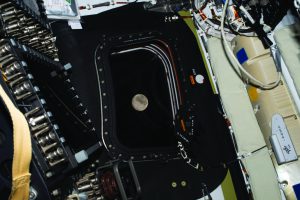
Artemis II sets sights on distance record, far side of moon
HOUSTON, April 6: NASA’s Artemis II astronauts embarked on a historic lunar fly-around Monday, aiming to set a new distance record from Earth and capture unprecedented views of the moon’s far side.
The mission marks NASA’s first crewed trip beyond Earth orbit since the Apollo era, with three Americans—Commander Reid Wiseman, Pilot Victor Glover, Christina Koch—and one Canadian, Jeremy Hansen, on board.
Artemis II followed a free-return trajectory, the same route used by Apollo 13, which allows a figure-eight path around the moon and back to Earth, minimizing fuel needs.
Less than an hour before the fly-around, the crew was poised to break Apollo 13’s 248,655-mile distance record, surpassing it by over 4,100 miles.
The Orion capsule will pass as close as 4,070 miles from the moon before turning back toward Earth, completing a four-day mission that ends with a Pacific splashdown on Friday.
During the six-hour flyby, the astronauts plan to study lunar features and take thousands of photos.
Key targets include the Orientale Basin, a massive multi-ring impact basin, the Apollo 12 and 14 landing sites, and the fringes of the south polar region, the intended landing zone for future missions.
The crew will also observe planets such as Mercury, Venus, Mars, and Saturn, as well as Earth.
Launched last Wednesday, Artemis II coincided with a total solar eclipse, which the astronauts could observe from behind the moon.
NASA geologist Kelsey Young highlighted the mission’s global significance, emphasizing humanity’s universal connection to the moon.
Artemis II sets the stage for Artemis III in 2027, when astronauts will practice docking with lunar landers, and for Artemis IV in 2028, which will include a moon landing near the south pole.
The mission echoes Apollo 8, humanity’s first lunar orbit in 1968, combining scientific objectives with a profound reflection on humanity’s place in the universe.
Victor Glover reflected on the experience as a reminder of shared human existence amid the vastness of space.
This mission represents both a technical milestone and a symbolic return to lunar exploration, paving the way for sustained human presence on the moon. (AP)