




By Christina K Sangma
The workshop had always smelled of warm leather and rain.
It stood at the edge of a quiet town, where time moved gently and days folded into one another like worn fabric. Inside, the walls were lined with tools that had outlived decades, needles, wooden moulds, and threads in earthy colours. At the centre sat her grandfather, steady and patient, as if he belonged to another rhythm entirely.
Emily had grown up watching his hands.
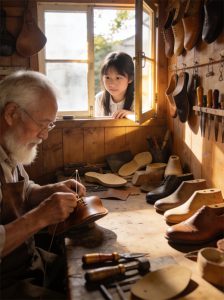
They moved slowly, but never uncertainly. Each stitch carried a quiet kind of knowledge, one not written anywhere but living in memory and muscle. He used to say that shoes were not just things people wore, they were companions that carried stories. A good pair of shoes, he believed, understood the road before the traveller did.
As a child, she laughed. Still, she stayed close.
She would sit beside him, trying her own uneven stitches, asking endless questions. Over time, she learned to listen, not with her ears, but with her fingers. To feel where the leather resisted, where it needed patience, where it would soften if treated kindly.
There was something almost magical in how broken shoes found their way back to life.
But as years passed, the town began to feel smaller. The world beyond called to her, brighter, louder, faster. Emily wanted to build something new, something that belonged only to her.
When she left for the city, she carried very little. No tools, no leather, only a quiet promise to return.
The city, however, had no patience.
Days became busy, then hurried, then crowded with ambition. Emily found herself swept into a world of ideas and endless possibilities. She learned, grew, created, but slowly, almost without noticing, the memory of the workshop faded into the background.
The smell of leather was replaced by polished floors and glass windows. The rhythm of stitching gave way to speed.
And then, one day, the news came.
Her grandfather had passed away.
The words felt heavy, filled with silence. When Emily returned, everything looked the same, yet nothing felt the same. The workshop still stood, but it no longer breathed as it once had.
Inside, the tools lay untouched, as though waiting.
In a corner, she found an unfinished pair of shoes. The leather was shaped but incomplete, paused mid-thought.
When she touched them, something stirred.
It wasn’t sudden. It was quiet, like a memory returning not to the mind, but to the hands. Her fingers began to move instinctively. The rhythm returned, not as something learned, but as something that had always been hers.
At that moment, she understood.
She had never truly left the craft behind.
The thought of giving away the workshop no longer felt right. It felt like ending a story too soon.
So she stayed.
The workshop changed, but it did not lose itself. Emily brought new designs, new ideas, new ways of reaching beyond the town. Yet at its heart, the craft remained the same,each pair made with care, shaped by hands that listened, carrying quiet stories within them.
And sometimes, in the soft glow of evening light, the workshop felt full again.
Not empty, not silent, but gently alive.
As though, in every careful stitch, her grandfather was still there, walking beside her, one step at a time.

