




A study of the Indian Ocean humpback dolphins off Goa’s coast found that the dolphins socialised and foraged less when tourist boats were around and the probability of foraging increased around fishing nets. When tourist boats and fishing nets were in the same feeding area, foraging declined, suggesting dolphins balance food access against human disturbance. India still lacks formal national guidelines for whale and dolphin watching. The study authors recommend limiting tourist vessels around dolphin groups and regulating approach distances. Mongabay India correspondent Sneha Mahale reports
For Indian Ocean humpback dolphins off Goa’s coast, fishing nets may offer feeding opportunities, while tourist boats often bring disturbance. A recent study, published in the journal Marine Ecology Progress Series, examined how the endangered species balances these competing responses when tourism and fisheries overlap in the same waters.
“Tourism and fisheries are among the most common human activities in the habitats used by these dolphins. We were interested in how dolphins respond when they have to balance disturbance from boats with the opportunity to access food resources,” says Imran Samad, corresponding author of the study and a scholar at the Centre for Ecological Sciences, Indian Institute of Science.
Watching dolphins from above
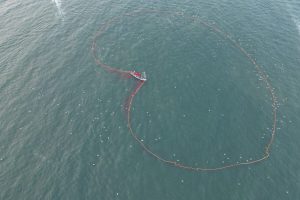
The study was carried out in north Goa between October 2023 and April 2024. The region supports relatively high densities of Indian Ocean humpback dolphins and also experiences intensive fishing and dolphin-watching tourism activity. Researchers monitored dolphin groups from elevated coastal vantage points. Once dolphins were sighted, they followed the animals using a drone, flown at a height of 60-100 metres above sea level.
“Traditionally, dolphin behaviour is studied either from the shore using theodolites (monoculars used to estimate dolphin positions) or from boats. We used drones, which allowed us to observe animals from above and follow individuals and groups without directly disturbing them,” says Samad.
Over six months, the team conducted 90 focal follows of dolphin groups and recorded 19 hours of dolphin footage. The footage was then analysed using machine-learning tools that tracked dolphin movements and estimated group size, swimming speed and movement direction.
Based on these observations, dolphin behaviour was classified into four categories: travelling, socialising, foraging and avoidance.
The researchers also examined how dolphins switched between these behavioural states under different combinations of tourism and fishing activity. The location of tourist boats and fishing nets relative to dolphin groups was recorded.
To understand seasonal changes in prey availability, researchers also monitored fish landings from purse-seine and gillnet fisheries, two common fishing methods used in the area.
Dolphin responses to tourist boats
When no tourism or fishing activity was present, dolphins spent most of their time travelling, followed by socialising and foraging. In the presence of tourist boats, the probability of socialising declined by 35%, and that of foraging declined by half.
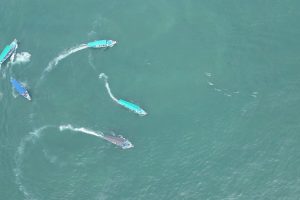
Researchers found that dolphins were more likely to avoid tourist boats when the boats approached more closely or surrounded them in larger numbers. Field observations showed that tourist boats consistently approached dolphin groups at high speeds. Dolphins often responded by diving and resurfacing farther away. As one boat located the resurfacing dolphins, others often followed.
According to the study, dolphin groups could be chased for hours as departing boats were replaced by new ones.
“We also found that responses varied depending on the level of disturbance and group size. Smaller groups seemed particularly sensitive. They were more likely to dive and reappear elsewhere, suggesting active avoidance. Larger groups tended to stay together on the surface and move away as a cohesive unit,” says Samad.
Dolphin foraging response to fishing nets
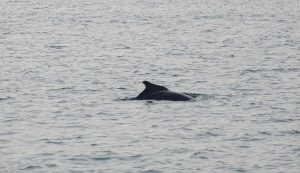 Goa supports relatively high densities of Indian Ocean humpback dolphins and sees intensive fishing and dolphin-watching tourism activity, which influence dolphin behaviour, according to a recent study. Image by Imran Samad.
Fishing nets were associated with a different set of behavioural changes. The probability of foraging increased considerably, by 330%, in the presence of fishing nets compared to undisturbed conditions. Particularly when they were closer to the nets, dolphins transitioned from travelling to foraging.
Most fishing interactions recorded during the study involved commercial purse-seine vessels targeting Indian mackerel and Indian oil sardine. Researchers frequently observed dolphins foraging in close proximity to these nets.
The increase in foraging or seeking food around fishing nets was the strongest during the low-catch season. At this time, when lower volume of fish was caught, the probability of dolphins foraging was almost 40% higher than during the high-catch season. Commercial catch rates were the highest during October and November and remained lower during the remaining months of the study period. During the low-catch season, dolphins also spent longer foraging near fishing nets.
According to Samad, seasonal changes in fish availability may influence dolphin interactions with fisheries. “During periods when fish such as sardines and mackerel are abundant, dolphins may have less reason to approach fishing nets. As fish densities decline, especially during the summer months, both dolphins and fishing activity may concentrate in areas where there are more fish, intensifying their overlap,” he says.
When tourism and fisheries overlap
The researchers also examined locations where tourism and fisheries occurred together. Dolphins near fishing nets were about 80% less likely to forage when tourist boats were also present than when only fishing activity was present. However, they were also less likely to display avoidance behaviour than when tourist boats alone were present.
Compared to instances involving only tourist boats, dolphins were 86% less likely to avoid the area and 55% more likely to forage, when fishing nets were also present. The findings suggest that dolphins may tolerate human activity when feeding opportunities are available nearby.
The study also found that smaller groups of one to four dolphins changed behavioural states more frequently than larger groups in response to interactions with tourist boats and fishing nets. They were more likely to switch to foraging around fishing nets and avoid tourist boats than larger groups.
However, the study did not assess whether these behavioural changes affect survival or population trends.
Measures to reduce disturbance
Samad says tourism and fisheries have long existed in these waters, but their intensity has increased considerably in recent years. “It is certainly something conservationists should pay attention to. At the moment, we still need more information to understand the long-term consequences. Behavioural changes can translate into population-level impacts through complex pathways, by affecting feeding efficiency, energy expenditure or habitat use over extended periods,” he says.
Longer-term monitoring will be needed to determine whether these behavioural changes have lasting effects on dolphin populations. In the meantime, based on their findings, the authors recommend several measures to reduce disturbance. These include limiting the number of tourist vessels around dolphin groups, regulating approach distances and avoiding approaches when dolphins are foraging near fishing nets. The authors also note that while dolphin-watching guidelines exist for some local populations, India still lacks formal national guidelines for whale and dolphin watching.
“One of the biggest challenges is that these stakeholder groups often operate in isolation. Tourism operators, fishers and government agencies frequently have different objectives and limited opportunities to coordinate their actions,” says Samad.
K Vaz, a boat operator in the area, says there are times when too many boats gather around the same dolphin group. Better coordination between operators and authorities could help reduce pressure on the animals while allowing tourism to continue. “We depend on dolphins for our livelihoods, so we also have an interest in making sure they are protected. If there are clear guidelines that everyone follows, it will be easier for operators and tourists to know what is acceptable on the water,” he says.
A practical first step would be creating a common platform where these groups can communicate and develop shared management goals. “Effective conservation will require cooperation rather than separate efforts by individual sectors,” says Samad.
Mongabay India / TWF

