




Rashik Biswa and Esha Chaudhuri journey through Shillong and Nepal to capture the spirit of Kukur Tihar, celebrating the gentle, loyal qualities that make dogs such cherished companions.
Coinciding with Diwali, Kukur Tihar—the festival of dogs—has captured hearts far beyond the Nepali community. Celebrated to honor the loyalty, unconditional love, and silent communication of our four-legged companions, the festival is as much a celebration of canine virtues as it is a gentle lesson for humans. This year, Sunday Shillong took to the streets to capture how the city embraces the colorful rituals, from adorned collars to ceremonial treats, bringing the spirit of Kukur Tihar to life.
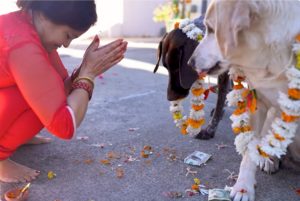
With its origins in Nepal, the festival honors dogs—strays and domesticated alike—by adorning them with flower garlands and applying tika (a vermillion mark on the forehead), celebrating their presence and intrinsic qualities. For decades, Shillong has witnessed the same vibrant traditions, brought to life by the city’s Nepali community.
 In Shillong
In the localities of Jhalupara, Barapathar, Nongsohphoh, and Upper Mawprem, Nepali residents know the stray dogs as companions. They are not pets in the usual sense, but familiar faces in the neighbourhood. Since these animals live right outside the closely packed houses in localities like Nongsohphoh, residents remember to honour them with delicious treats during Kukur Tihar. This generosity towards the furry companions isn’t limited to just one day.
A pack of dogs can almost always be found basking lazily outside a shop in Upper Mawprem. They are fed and cared for, yet continue to live the stray life. Their well-being, however, should not be a question, as compassionate residents ensure they have food and shelter.
A large number of strays also roam the streets of Mawbah. On Kukur Tihar, they can even be seen wearing garlands and sporting the ceremonial red tika on their foreheads.
Overall, the Nepali community shows kindness towards these animals. Even if they cannot adopt every one of them, they make sure not to harm them and allow them to live freely.
From “Tommy” in the 2010s to “Shiro” in the 2020s, locals have witnessed these furry friends being garlanded and treated like royalty during Kukur Tihar in their localities.
Rituals typically begin in the morning and continue through the day. As the house is cleaned and decorated for the celebrations, simultaneously the dogs are honoured with garlands made of flowers, most houses use marigold flowers to make a garland. Together, a red tika almost always made of rice, yoghurt and vermillion, is applied on their foreheads.
The dogs are offered a meal comprising meat, typically chicken, boiled eggs, chapati or rice, depending upon the household, and anything that their pets are very fond of. For strays, they are offered rice and chicken. However, these aren’t just offered as feeding, but as ritual prasad.
In the entire process priests have no involvement in their puja and most households take the initiative individually.
As a devoted dog parent, who observes Kukur Tihar with Winter, their pet, Bipana Thapa says, “I express my heartfelt gratitude to my dog for the unwavering loyalty and companionship she has given me. Her presence serves as a reminder of the deep bond between humans and their pets — a relationship built on trust, affection, and mutual care. Beyond being a loyal companion, she has become a source of comfort and happiness, demonstrating the powerful emotional connection that exists between people and their animals. Her paw prints have left a lasting mark not only on my heart but also on my life.”
 In Nepal
The festival of dogs or Kukur Tihar in Nepali is as old as the celebration of Diwali itself. It is rooted in ancient scriptures and is witnessed across the country during this time of the year. Speaking with a resident of Nepal and observer of the festival itself, Nirnaya Bhatta says “The festival has to be looked at Kukur Tihaar vis-a-vis Deepawali and the five days of Yama Panchak, where the first day is dedicated to crows and the second day is for dogs, third is when cows are worshipped, fourth is goru tihaar or for the oxes and the fifth is bhai tika.”
Bhatta explains that these five days culminate with the Deusi Bhailo, a traditional Nepali ritual where groups especially women and girls go door-to-door singing and dancing, offering blessings and receiving sweets and money.
Bhatta underscores the significance of the festival to foster compassion for dogs but then again also highlights the contradiction especially during Diwali through lighting of firecrackers. He says, “We worship dogs in the day but light firecrackers in the night. In Nepal, after the insurgency in 1996-2006, selling of crackers is prohibited here.”
Bhatta who recently lost his German Shepherd, Happy,
Overall, the ritual is more or less the same across Nepal and Shillong with a few peculiarities observed amongst the Newars in Kathmandu. However, the festival is more vibrant in the rural areas than now in the urban spaces. The festival goes on to reiterate the positioning of dogs in Hinduism, mythology and culture. Whether the association with Bhairava, a fierce form of Shiv, dogs are depicted as protectors and guardians, or Dattatreya, an incarnation of the trinity of Brahma, Vishnu, and Shiva, is often depicted with four dogs symbolising childhood, youth, old age, and death. Beyond the gods, dogs are also seen as a symbol of ego and attachment based on the idea that dogs are fiercely loyal and protective of their masters, and can become attached to them. This attachment is seen as a symbol of the ego’s attachment to worldly things. Apart from Nepal, in some parts of India, dogs are worshipped as a symbol of loyalty and protection. This worship is often done by offering food and prayers to dogs, especially on specific days like Bhairava Ashtami.
Dogs have historically represented qualities that humanity can both learn from and aspire to emulate. Given the alarming rise in violence against them, it is crucial to highlight the importance of acknowledging and honouring their enduring presence in human life.

