



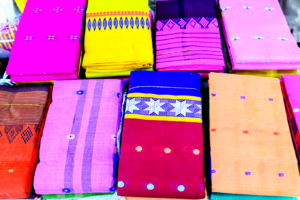
Weavers of iconic Tangail saree in B’desh seek UNESCO recognition
DHAKA, Dec 7: The weavers’ neighborhood near Dhaka echoes with the constant clatter of the looms with rhythmic hand movements as the artisans use colorful silk and cotton threads to weave the iconic Tangail saree.
The garment is seen as the country’s cultural symbol, showcased during festivals and wedding celebrations across the Indian subcontinent.
The centuries-old traditional saree weaving art was nominated for inclusion in UNESCO’s list of Intangible Cultural Heritage of Humanity this year.
Calling themselves “the magicians of glass,” their clients have included Swarovski, the French chain Galeries Lafayette, and Harrods, the iconic London department store.
The sarees are hand-woven on a handloom, often incorporating a jacquard loom for intricate patterns. A key feature is the “extra-weft buti” technique, where tiny, repeated motifs are woven into the fabric, appearing almost like embroidery.
They are predominantly woven from fine cotton or silk threads, which makes them soft, comfortable, and easy to manage.
Tangail sarees are known for their vibrant colors and various geometrical or floral designs. A classic and auspicious combination in Bengali culture is the white/off-white body with a red border.
The weaving style is considered a simplified version of the more complex Jamdani textile, making it generally more affordable while still maintaining a rich artistic heritage.
The Tangail saree is not just a cultural icon, it also provides livelihood to hundreds of weaver families.
The craft originated in the Tangail district, but the popularity of these sarees spread throughout the undivided Bengal region.
After the partition, many skilled Hindu weavers (Basak community) migrated to West Bengal, India, particularly in the Nadia and Purba Bardhaman districts (like Phulia), where they continue to produce these sarees, evolving into a hybrid style that blends Tangail and Santipuri designs.
With rising raw material costs and competition from cheaper, machine-woven drapes, the community is facing waning interest from younger generations to continue in the family vocation.
Handloom weavers hope the recognition and heritage status from UNESCO will help preserve their craft for future generations. (Agencies)
