



Editor,
The special article “Who is a Khasi? Tradition, Genetics and the politics of identity” by Bhogtoram Mawroh (ST December 30, 2025) made interesting reading. According to Hamlet Bareh the author of “The History and Culture of the Khasi People” ‘Kha’ means born of a mother and ‘si’ means ancient mother. The Khasi have a decentralized political structure, with chieftains (Syiem) and councils (Durbar) managing local affairs. This system reflected their emphasis on community consensus and clan representation. If this is tampered what happens to this system? The Khasi political system is not just administrative; it’s deeply tied to their social fabric and clan-based identity. If the decentralized structure of Syiem (chieftains) and Durbar (councils) is tampered with, several consequences unfold:
Structural Consequences
Loss of Consensus-Based Governance: The Khasi system relies on collective decision-making through clan representation. Tampering weakens this, leading to more centralized or imposed authority that may not reflect community will.
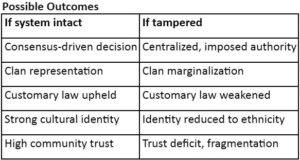 Erosion of Clan Autonomy: Each clan (Kur) has a voice in governance. If the system is disrupted, clans lose their role in shaping decisions, undermining matrilineal balance.
Weakening of Customary Law: Khasi customary law (Ka Tip Kur Ka Tip Kha) is enforced through these councils. Without them, traditional dispute resolution and justice mechanisms collapse.
Cultural & Social Impacts
Identity Dilution: Governance is part of Khasi cultural identity. If tampered, Khasi-ness risks being reduced to ethnicity alone, stripped of its institutional expression.
Trust Deficit: Community trust in institutions erodes when decisions no longer emerge from consensus. This can fragment society and fuel conflict between clans.
Generational Disconnect: Younger Khasi may grow up without exposure to participatory governance, weakening cultural transmission.
Wider Implications
Legal Conflict: Tampering often clashes with constitutional protections for Scheduled Tribes, sparking legal disputes.
Political Tension: Central/state/District Council interventions risk being seen as cultural intrusion, leading to resistance movements.
Resilience vs. Vulnerability: The Khasi system has historically adapted (e.g., under colonial rule), but repeated tampering could push it toward irreversible erosion.
If the Khasi decentralized system is tampered with, it risks losing its participatory essence, clan balance, and cultural legitimacy. What remains may look like governance, but it would no longer be Khasi in spirit — it would be a hollowed structure, disconnected from the people it represents.
Yours etc;
VK Lyngdoh,
Via email
Beyond the Slurs: What really killed Anjel Chakma
Editor,
The brutal murder of Anjel Chakma, a 24-year-old MBA student from Tripura, has left us all in shock and pain. This young man from the Northeast came to Dehradun chasing dreams, only to lose his life to a savage attack on December 9. After 17 days of fighting injuries, he passed away in hospital. It’s a heartbreaking loss—one that demands answers, not just anger.
As an Indian Gorkha from Shillong, I’ve faced my share of racism too—in mainland India, the Northeast, and even here in the hills. Being called names or stared at like an outsider hurts deeply. It builds walls where there should be bridges. But Anjel’s death has me asking tough questions. Is racism the full story, or is something else at play? We must dig deeper before jumping to easy labels.
First, reports say one of the main suspects is from Nepal. Yet, he allegedly hurled slurs like “momo” and “Nepali” at Anjel. Why would someone from Nepal use those exact words against a Chakma student? It feels off—like the taunts were borrowed from a script, not born from real hate.
Then there’s the accused from the Northeast himself. Why would he call Anjel “Chinese”? People from our region know better; we’re all too familiar with these lazy stereotypes ourselves. It raises doubts: Was this a group frenzy gone wrong, or something more personal?
And the two juvenile suspects? They’re Paharis from the hills, with features much like Anjel’s own. They look like they could be from the same communities we all hail from. If racism was the spark, why turn on someone who mirrors you?
I’m not denying the ugly slurs—”Chinki,” “Chinese,” “Momo”—that started the fight near a liquor shop. They echo the poison we fight every day. But rushing to pin this as pure racial hate risks missing the truth. Was it a brawl over something petty that exploded? Drugs, egos, or old grudges? A proper probe is urgent. The police have arrested five, including the two minors sent to a juvenile home and one Nepali suspect still on the run. But we need facts, not headlines.
What’s worse, some voices are already twisting this tragedy to widen cracks in the Northeast. Anjel was one of us—a son of the hills, studying far from home. Using his death to stir up old divides between communities won’t bring justice. It only deepens the wounds.
I urge the Home Ministry and Prime Minister’s Office to watch this closely. Shift the trial out of Uttarakhand if needed, as tribal groups are demanding, to ensure fairness. Let experts investigate every angle—medical reports show Anjel suffered paralysis and brutal blows to the head and spine. No cover-ups, no shortcuts.
Anjel deserved better. So do we all. In a country as diverse as ours let’s honour him by seeking the real why, not just the easy who. Only then can we heal—and prevent the next heartbreak.
Yours etc.,
Anil Thapa,
Via email
