



ICC Men’s T20 World Cup
Dominant, but Not Flawless as India’s Semifinal Test Awaits
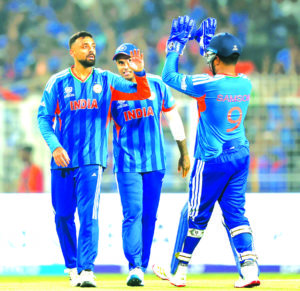 Kolkata, March 2: For the better part of the last two years, India’s T20 side has carried an aura of inevitability. Big chases were reeled in with calm assurance. Defendable totals were defended with clinical precision. Individuals rose when required, and the collective rarely faltered. There was a rhythm to their dominance, a quiet authority that made them look, if not invincible, then certainly a step ahead of the rest.
And yet, at this T20 World Cup, amid the victories and the roar of packed stands, there have been tremors beneath the surface. India have surged into the semifinals, but not without revealing a few cracks that could widen against sterner opposition.
Samson’s resurgence
Few narratives have been as compelling as that of Sanju Samson. On the eve of the tournament, his form had dipped alarmingly. A string of low scores pushed him out of the starting XI, with Ishan Kishan preferred at the top alongside Abhishek Sharma. Samson watched from the sidelines as India navigated the early group-stage fixtures.
Rinku Singh’s sudden exit due to a family emergency disrupted the balance of the side. Opposition teams, meanwhile, began exploiting India’s cluster of left-handers with off-spinners operating from around the wicket.
The think-tank, led by head coach Gautam Gambhir, recalibrated. Samson was recalled to inject a right-handed presence and tactical flexibility at the top.
Against Zimbabwe in the Super Eights, Samson provided a brisk, authoritative start that allowed the middle order to play without inhibition. But it was his unbeaten 97 against the West Indies at Eden Gardens that truly shifted the narrative. Chasing 196 in a virtual knockout, he blended timing with calculated aggression, dismantling both pace and spin. The knock was not merely fluent; it was decisive. India sealed their semifinal berth with four balls to spare, and Samson had emphatically vindicated the faith reposed in him.
Gambhir was effusive in his praise, reiterating that Samson’s quality had never been in doubt. The innings, he suggested, was a glimpse of the world-class talent the 31-year-old possesses — and perhaps a turning point in his World Cup story.
Pace under pressure
If Samson provided the sparkle with the bat, India’s fast bowlers ensured the damage never spiralled out of control.
On a flat Eden Gardens surface where the West Indies threatened to breach the 210-mark, Jasprit Bumrah’s spell of 2/36 was a study in control. He absorbed pressure, varied his pace, and refused to allow the innings to explode at the death. Arshdeep Singh complemented him with remarkable composure, conceding just six runs in the penultimate over. That frugality forced the Caribbean side to settle for 195.
India’s eventual win, achieved with only four balls remaining, underscored how those 10–15 saved runs proved pivotal.
Arshdeep also struck thrice against Zimbabwe, while Bumrah stood tall in the Super Eight clash with South Africa, returning figures of three wickets at a miserly economy of 3.75 when others struggled for rhythm. Even on days when the bowling unit looked stretched, Bumrah’s discipline remained the constant. Another subtle yet significant adjustment has been Tilak Varma’s repositioning in the batting order.
Previously slotted at one-down, where he appeared tentative in recent outings, Tilak has now embraced the finisher’s role at No. 5 or 6. Freed from the burden of anchoring, he has flourished. Against the West Indies, he scored at a strike rate brushing 200, counterattacking in the middle overs while ensuring stability did not erode. The move has lent India’s middle order both flexibility and firepower — a valuable asset heading into knockout cricket.
The concerns beneath the surface
For all the positives, the World Cup campaign has not been flawless.
Abhishek Sharma, ranked as the No. 1 T20I batter coming into the tournament, has endured a perplexing slump. Three ducks and a string of subdued scores have blunted India’s powerplay dominance. An early bout of food poisoning may have disrupted his rhythm, and while he has attempted to rotate strike and build innings, his shot selection has drawn scrutiny.
Against a side as formidable as England, India cannot afford to be reeling at 20 for 2 inside three overs.Fielding, too, has been erratic. Abhishek dropped two straightforward chances against the West Indies, one of which allowed Roston Chase — then on 15 — to rebuild and eventually top-score with 40. Varun Chakravarthy missed a direct hit in the same match. India’s catching efficiency, at 71.7 percent, is the lowest among the Super Eight teams.
In knockout matches, such lapses often prove decisive.Then there is the question of spin control. Varun Chakravarthy was incisive during the group stage, operating at an economy of 5.16.
As the competition intensified, that figure ballooned to over 10. He was expensive against South Africa, Zimbabwe and the West Indies, occasionally leaking runs during middle-over assaults. Gambhir was seen in extended discussions with him at Eden Gardens, fine-tuning lines and lengths. With England looming, the mystery spinner remains central to India’s plans — but sharper execution will be essential.
The semifinal beckons
India now face England at the Wankhede Stadium on March 5 — a contest that promises intensity and nuance in equal measure. Led by Harry Brook, England have blended individual brilliance with collective resilience. Brook’s astonishing 100 off 51 balls against Pakistan in the Super Eight stage — the first century by a captain in T20 World Cup history — epitomised their fearless approach.Gambhir has acknowledged the magnitude of the challenge.
England, he insists, are a world-class outfit brimming with match-winners. Playing at the Wankhede, with its quick outfield and fervent crowd, will test temperament as much as technique. For India, ticking every box — from fielding sharpness to powerplay stability — could determine whether this campaign culminates in silverware. (Agencies)
