

By Esha Chaudhuri
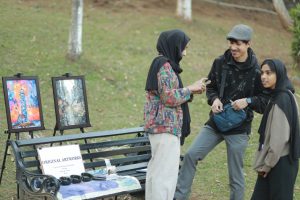
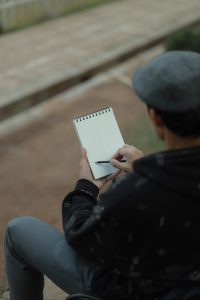
A stroll along the pathway inside Wards Lake, and one will spot an artist sitting on a bench immersed in creating handmade paintings. Though often unassuming, the artist, Benjamin Majaw (26) is hard to miss. Sometimes seated, sometimes standing, sometimes engaging with ongoers, Majaw draws what comes to mind when sitting amidst nature.
 On being asked why he chose the lake as his space, he replies, “It was never a first thought to be showcasing my work there.
My initial intention was close to home. The lake came to mind as a window of opportunity while I was walking to someplace vibrant with colours in Shillong. Sitting by the lake, observing light, reflections, and people, allowed me to slow down and truly see.” It became more than just a place—it became a part of his process. While seated there, he has had the privilege to explore impressionism, capturing fleeting moments and shifting moods through his sketches. He adds “In many ways, that decision opened doors to my personal growth – not just as an artist, but as an observer of the world around me.”
He recalls several memorable interactions with visitors, both young and old.
He narrates, “I remember meeting a group of students from Arunachal Pradesh, around the age of 12-16, who were visiting with their teacher. They praised my work and asked me to never stop pursuing what I’m passionate about. We even took pictures together—something I’ll always hold onto.”
 He also met an American who spoke with him at length about what he felt about an art-piece he did. They had a profound conversation about art and even wanted to buy the piece he had just made.
Lastly, “There was also a Gujarati gentleman who asked for my signature on his shirt—such a simple yet humbling gesture that stayed with me” says an excited Majaw.
The Journey
A resident of Jaiaw, who had studied at Seven Set School and then Science till his Bachelor’s, Majaw heeded to his inner voice to pursue his dream of becoming an artist. He recalls his earliest memories of scribbling on a desk table while staying at his grandmother’s place. He says, “I loved sketching from a young age. The handing of the pencil, the shades and the small details in a sketch. As I grew older, my decisions were shifting. I chose to study Science, but it never felt like where I belonged. I knew I couldn’t spend studying the same subject anymore which drove me to the point of dropping out from college.”
Majaw was deeply inspired by a quote by Steve Jobs – “You can’t connect the dots looking forward, you can only connect them looking backwards.” Majaw says “That quote resonated with me starting out.
 So I started, without a fixed goal, but with intent. I wasn’t arrogant, but I believed in my ability. I began setting small milestones for myself, taking one step at a time. I pushed myself to step out, to speak to people, to present myself as an artist. Slowly, I found people who wanted portrait sketches of themselves, and that’s where things began to take shape.”
His journey had many uncertainties and setbacks but he believed in himself and his craft. The rest is history. In his unconventional path, reflecting on the role of his parents and family in shaping his life interests and career goals, Majaw says, “My family has played quite a significant role in shaping who I am today. One moment that stands out is when my father gave me a room in 2025 to conduct art classes. It may seem like a simple gesture, but for me, it meant trust, belief, and space to grow – not just as an artist, but as a person.”
The Artistry
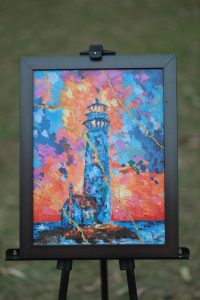
On being asked what kind of art do you do? The young artist emphatically answers, “When it comes to adding colour to a canvas, I lean towards abstract art – often intertwined with 20th-century movements like Expressionism and Impressionism.”
 He is particularly drawn to these styles is their ability to go beyond form and capture emotion, movement, and fleeting moments. At the same time, he also tries to ground his work in philosophical meaning. He adds, “My paintings aren’t just visual expressions – they’re reflections of ideas, emotions, and personal interpretations of concepts like transformation, acceptance, and growth. I’ve also been exploring Fauvism, particularly its bold and vibrant use of colour. It’s helped me become more fearless in my palette and more expressive in how I translate feeling onto the canvas.”
The artist, who sketches and paints by the lakeside, draws inspiration from a mix of internal reflection and external observation – the world around him, the people he meets, and the philosophies that he connects with. “It’s a continuous process of exploring both what I see and what I feel” he emphasises.
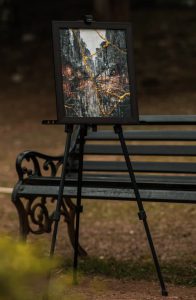 About his idol from the art world, he says the first person who comes to mind is Devon Rodriguez, a portrait artist from New York City. “What inspires me about him is that he feels like more than just an artist. Through his work, he creates genuine human connections, especially in the way he interacts with people while drawing them. It’s not just about the final piece, but the experience and emotion behind it. That’s something I deeply resonate with. I believe art goes beyond technique – it’s about presence, storytelling, and connection.”
Much like his muse, Majaw also showcases his work by the Lake, a public space, where interaction with people is plentiful. These exchanges add a whole new dimension to his work. “There’s a certain honesty in those moments; the way someone pauses, reflects, or resonates with a piece. It reminds me that art isn’t just meant to be seen, but to be felt and shared” Majaw says.
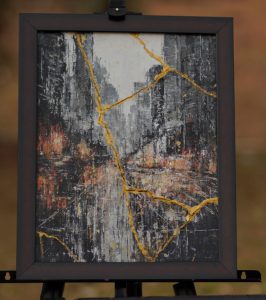
Like every artist, Majaw’s work also carries a backstory. He agrees. He says every piece that he creates carries a story, but one of his recent favourites is a painting titled ‘Beauty through Becoming’ that is special to him.
“I created it using palette knives, allowing the texture itself to speak – raw, layered, and imperfect. That choice of tool was intentional, as I wanted the process to mirror the meaning behind the work. The painting explores the idea of Metamorphosis – a transformation not born from perfection, but from fracture. It is deeply connected to the Japanese philosophy of Kintsugi,which embraces the beauty of repair.
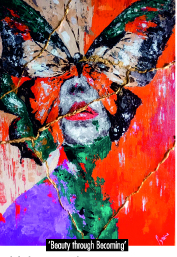 In the piece, every crack is not something to be hidden, but something to be illuminated. The gold does not conceal the damage, it honours it. What was once broken becomes a part of its identity -stronger, more meaningful, and more whole in its own way” describes Majaw.
For him, this painting is a reflection of becoming – of understanding that growth often comes through moments of breaking, and that there is a quiet beauty in putting ourselves back together.
As an artist, Majaw considers himself an avid learner. He loves exploring art and his goal is continuing exploring themes of healing, imperfection, and transformation. While his art pondering continues, Majaw has also been writing. He has written two books bridging the world of art and philosophy.
So the next time you’re at Wards Lake, take a moment to pause – you might just discover not only an artist, but a story that stays with you.



