



New roads: Built to last…two weeks
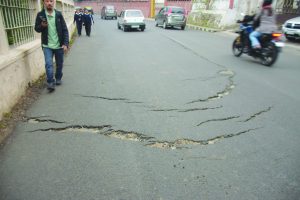 The political class in Meghalaya has a favourite hobby—blaming the Shillong weather, heavy vehicles, and climate change for all broken roads. But this time, even they’re left embarrassed.
A road resurfaced just two weeks ago in the heart of the city has already started tearing apart. The damage is right in front of the DC’s Office, a prime location where officials drive past daily. The state government is currently spending around Rs 45 crore to resurface major stretches of Shillong road after the much-hyped “Smart Road” plan failed spectacularly and got quietly buried.
Yet here we are: fresh bitumen peeling off like old paint, one side of the road done while the other side looks abandoned for weeks, and road markings so inconsistent that even the white lines seem confused about which side they belong to.
Passers-by are not impressed. “It shouldn’t take this long to finish one stretch,” said a few, while staring at the half-done job on MG Road.
On social media, people are roasting the PWD hard. “Rs 45 crore for two-week roads? Even a phone’s warranty lasts longer,” one commented.
The PWD and the government are left red-faced as citizens wonder: Are our roads allergic to money, or is this just another episode of “Meghalaya Infrastructure: Crumble Edition”?
At this rate, we might need to start calling them “temporary roads” instead of “new roads.”
Of roadworks and gridlocks…
The stretch near Pine Mount School has long been infamous for traffic snarls, but, in recent days, the situation has worsened significantly, turning the area into a daily chokepoint that tests the patience of commuters.
With one side of the road along the school boundary wall dug up for ongoing work, the usable carriageway has narrowed drastically. On the opposite side, parked vehicles further constrict movement. Adding to the chaos are specific hours during the day when traffic is allowed from both directions, creating a near-gridlock situation.
The result is a familiar yet frustrating scene: long queues of vehicles, blaring horns and visibly agitated commuters. While traffic police continue to manage the situation on the ground, often preventing a complete standstill, the pressure on the stretch is unmistakable.
Immediate traffic management, however, does not address the broader concern.
If this road has effectively become a bottleneck, why do long-term solutions remain elusive? Alternative routes introduced over time have provided only marginal relief, whilst the core problem persists.
The situation raises pressing questions for the authorities. How long can temporary adjustments and manual regulation substitute for structural planning? With multiple such chokepoints across Shillong, is the city’s traffic strategy keeping pace with its growing vehicle load?
There is also a growing concern that solutions are being deferred in anticipation of larger projects, such as the proposed development of New Shillong Township and the eventual relocation of offices. But can the city really afford to wait for long-term plans to materialise while daily congestion disrupts lives?
For now, the burden falls on commuters and traffic personnel alike—one enduring the chaos, the other trying to contain it. The lingering question is whether this stretch will continue to be managed reactively, or if a decisive, forward-looking intervention is finally on the horizon.
