



By Mai White
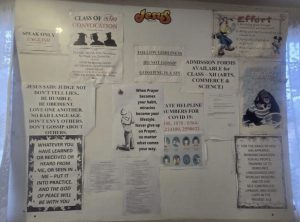
The first thing that meets you at the gate is a soft chorus of intention. Words gather there as quiet declarations: no harming wild birds, no weapons, no smoking. They feel less like rules and more like a promise the school has made with the world. “Bird & Butterfly Haven” lingers in the air, as if something delicate might answer it. Even before stepping inside, the place feels alive, as though learning begins with noticing and protecting life.
Then other voices emerge—science seminars, DNA extraction, achievements across disciplines. The language shifts from care to ambition, from sanctuary to striving, yet it does not feel contradictory. It feels balanced. A place that teaches how to grow without losing kindness. There is pride too, but it is quiet and earned, something patient and steady. Standing at the gate, it feels like a threshold between worlds: one where butterflies are protected, and one where futures are built—and somehow, they are the same.
As I entered, I was greeted by a gentle smile. A lady asked softly, “Are you the Vietnamese lady?”
“Yes,” I replied, “I texted.”
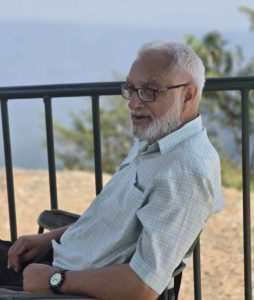
Beside her stood a man with a Santa-like beard, smiling warmly. “It was me who texted.”
In that moment, something settled. I felt at home.
We sat under the shade, the morning sun softened by trees. They asked if I had eaten. When I said no, breakfast appeared—simple, generous. The lady, Madam Dancy Syiem, the principal, moved through the space with calm efficiency, attentive yet unhurried.
Peter Sir sat with me, speaking slowly, asking me to raise my voice as his hearing had weakened. There was no complaint in it, only acceptance.
“I am half the man I used to be,” he said gently. “I have lived the life of ten people.”
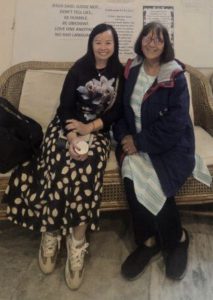
He showed me a record book—what remained. The rest had been lost in a fire in April 2016. “Everything,” he said quietly.
And yet, beyond us, a new building stood tall in the sunlight—blue, steady, resilient. Something rebuilt. Something that refused to disappear.
In the yard, a large bus waited, worn but ready. Girls began to gather, greeting one another with soft laughter and ease. Their politeness was striking—gentle, almost reserved, yet warm. Some carried instruments, placing them carefully onto the bus.
I remembered his message: an invitation to join their trip to Sohra (Cherrapunji) for a picnic and environmental study. And there I was, the next day, with a backpack and quiet anticipation.
Before departure, Peter Sir gathered the girls. The morning seemed to pause.
He spoke not hurriedly, but with quiet clarity, guiding them through the land they were about to travel. He described the Meghalaya ridge behind them, its peaks rising above 6,400 feet, then traced the descent toward Sohra (Cherrapunji). His words painted the journey before it began—the gradual slopes, the sudden drop toward Bangladesh, the shift from plateau to deep gorges.
“You must observe,” he said. “Not just look.”
It was not just a lesson in geography, but in attention.
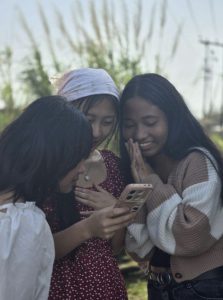 We set off around 10am, the bus winding through the hills as laughter filled the air. Houses clung to slopes, tin roofs catching the light. Roadside stalls displayed fruits and pineapples. Women in colourful shawls stood watching the day unfold. The mist moved like a quiet companion, wrapping the landscape in something almost magical.
The girls sang as we travelled, their voices rising and falling with the road. I found myself smiling without realising.
As the journey continued, the land opened into vast green valleys. Waterfalls appeared like silver threads slipping down cliffs. Children waved as we passed. Men carried baskets along narrow paths. Cows wandered freely, unbothered.
It reminded me faintly of Vietnam, yet larger, wilder.
The staff pointed out places along the way, sharing stories. I listened like a student again, learning through movement, through seeing.
 For the first time, surrounded by these students and teachers, I felt a quiet sense of belonging. We shared snacks, small conversations, moments that needed no perfect language. As we neared Sohra (Cherrapunji), the air grew cooler, fresher, almost sacred. It felt like more than a trip—it was a crossing between places, between versions of myself.
We arrived after several gentle stops along the way. Each pause felt like a gift. When we gathered again, Peter Sir spoke about the environment—not as theory, but as something living, something requiring care.
Madam Dancy moved among the girls, checking on them, teasing lightly, listening with patience. Her presence carried the warmth of a mother, the gentleness of a grandmother, and the attentiveness of an educator. The head teacher shared this same quiet care. It was never announced, only felt.
The place revealed its beauty slowly. Thin streams slipped down rocks like delicate threads. In the rainy season, they would become powerful waterfalls, but even now they hold a quiet magic. Small rainbows shimmered in the water if you looked closely.
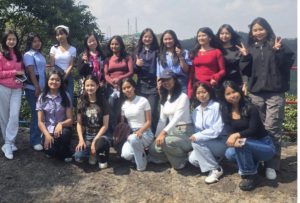 Around me, the girls laughed, took photos, and called out to each other. Their joy filled the space. We shared a simple meal and lingered longer than planned. Conversations deepened, becoming more personal, as if time had slowed to allow connection.
When it was time to leave, the journey back felt softer, more reflective. The bus grew quieter. I drifted in and out of sleep, waking often to catch the passing hills and changing light.
Back on campus, Madam Dancy showed me around. Classrooms, laboratories, spaces for DNA study, computers, the library, sports areas. Nothing extravagant, yet everything purposeful. It was clear the students had what they needed—to learn, to explore, to grow.
Soon, the atmosphere lifted again. Music played, and the girls began to dance—freely, joyfully. Their laughter returned in waves, softer now, touched by the fullness of the day. Some clapped, others joined, a few simply watched with bright smiles.
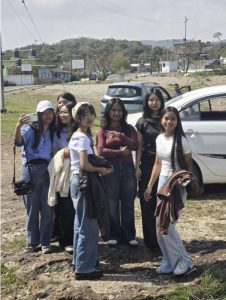 We had tea together, simple and comforting. It was a quiet in-between moment—balanced, complete.
Before coming, I had heard vague rumours of challenges in the school’s past. But standing there, those whispers felt distant. What I saw instead was a school grounded in care—in the way teachers spoke, in the humility and confidence of the students, in the quiet emphasis on environmental values.
Every place has its difficulties. What matters is how it stands again. And here, it stood—steady and dignified.
There was also a sense of continuity. An old student visited while I was there, someone who had studied more than thirty years ago. He spoke with deep affection about the school and his teachers. That kind of lasting connection can only come from something genuine.
Care extended beyond the classroom. The head teacher watched over the students attentively throughout the trip. The driver navigated the winding roads with patience. Two male assistants supported quietly in the background. Among the group was one schoolboy, the only male boarder, moving comfortably within this environment, while eight girls were boarders, forming a close-knit family.
It felt less like a formal trip and more like a shared responsibility, where each adult contributed to a space that was safe, simple, and reassuring.
I returned home with a full heart. It was more than a visit. It was an experience of care, connection, and a deeper understanding of education—not just as knowledge, but as character and kindness.
Even now, I feel there is more to say—especially about Peter Sir: environmentalist, storyteller, a man of humour and depth. I can still hear his voice, half playful:
“In your book, you should include The Man–Elephant Confrontation.”
And I know—that is a story waiting to be told.
Mai White (pen name: Vo Thi Nhu Mai) is a Vietnamese poet, translator, editor, critic, and Senior Teacher based in Perth, Western Australia, whose work spans more than two decades of bilingual writing and cultural advocacy.
