



By Our Reporter
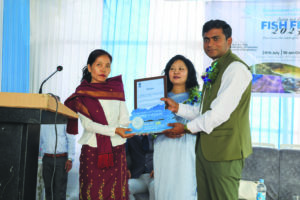
SHILLONG, July 24: Fish farming in Meghalaya isn’t just growing, it’s thriving; and this year’s Fish Fest, 2025, held as part of National Fish Farmers’ Day, corroborates just that!
Hosted by the Department of Fisheries at its Shillong headquarters on Thursday, the festival brought together progressive fish farmers, district officials, aquaculture experts and partners from across the state.
“Fish Fest 2025 is a celebration of our farmers’ hard work and a platform for collaboration,” said Secretary of the Fisheries Department, SC Sadhu.
“It highlights the sector’s economic and environmental value, and the need to reduce our reliance on outside supply. With the upcoming State Aquaculture Mission 3.0, we aim to tackle infrastructure, technology and market gaps. The goal is clear: nurture entrepreneurial farmers, boost local production and build a self-reliant fishery ecosystem in Meghalaya,” he said.
“Though we’ve increased our production four to five times compared to a decade ago, 30 to 40% of fish still comes from outside the state. There is huge untapped potential within Meghalaya,” he added.
Each district was tasked with showcasing its unique contributions. East Khasi Hills brought in fresh fish along with trout and dry fish. West Jaintia Hills highlighted smoked fish (Kha Rang) and fresh mahseer (Kha Saw). On the other hand, Ri-Bhoi showcased Java Puthi (Java Puthia), while Eastern West Khasi Hills and South West Garo Hills focused on value addition. Similarly, Meghalaya State Fisheries Research & Training Institute (MSFR&TI), Mawpun, presented modern aquaculture technologies.
The people behind these products are finally getting the spotlight they deserve.
Awards were conferred upon standout farmers from both the Khasi-Jaintia-Ri Bhoi region and the Garo Hills.
From East Khasi Hills, Barilang Skhemblon clocked 5.25 MT of fish production, earning Rs 13.13 lakhs. In East Jaintia Hills, Lamsing Tynsong produced 3.503 million fish seeds, generating a staggering Rs 70 lakhs. Meanwhile, Danosha Tlang, also from East Jaintia Hills, topped fish feed production with 330 MT and an income of Rs 130 lakhs.
Garo Hills had its own champions. Jranggrim C. Marak from East Garo Hills produced 1.80 MT of fish, earning Rs 4.50 lakhs, while Almith Momin delivered 2.85 million fish seeds, earning Rs 57 lakhs. South Garo Hills’ Kerina R. Marak hit 82 MT in feed production, pulling in Rs 41 lakhs.
These numbers reflect years of commitment, smart practices and support under schemes like Blue Revolution and Rashtriya Krishi Vikas Yojana.
