



By Lamphrangbor Nongspung
 Renowned Khasi filmmaker Pradip Kurbah’s latest film Ha Lyngkha Bneng – The Elysian Field is a poignant meditation on urban migration, fading villages, and the enduring strength of human connection.
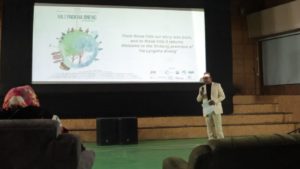
After travelling across several international film festivals and earning prestigious accolades, the film was recently screened for a select home audience at the auditorium of St Anthony’s College, Shillong, on Friday.
The special screening was organised by the Department of Mass Media, St Anthony’s College, in collaboration with Kurbah Films, Hello Meghalaya, and Ka Knup Creatives.
The event marked an emotional homecoming for the film, which has already garnered Best Director, Best Film, and Best Asian Cinema awards in Moscow, Best Director at the Kolkata Film Festival, and Best Editor at an international film festival in London.
 The film continues to travel widely, drawing appreciation for its sensitive storytelling and cinematic finesse.
Set in the year 2047 in the quiet Khasi Hills of Meghalaya, Ha Lyngkha Bneng imagines a village reduced to just six inhabitants as most families have migrated to cities in search of better opportunities. Shot over a period of more than two years across the misty plateaus and soul-stirring landscapes of Sohra, the film is visually striking and emotionally restrained.
 At its heart, the story is about community. In an almost empty village, the remaining residents depend on one another for companionship, support, and survival.
Through shared memories, gentle conversations, moments of silence, and everyday interactions, they hold on to a sense of belonging even as the village around them slowly fades away. Each character carries personal dreams, regrets, and hopes—some longing for the past, others waiting for change, and a few simply choosing to remain rooted in the land they love.
 The film gently reminds viewers that even when places begin to disappear, human connection can endure. It is a story of love, loss, resilience, and quiet hope in a rapidly changing world.
The ensemble cast includes Richard Kharpuri (Complete), Albert Mawrie (Livingstone), Baia Marbaniang (Maia), Jeetesh Sharma (Friday), Helen Duia (Miss Helen) and Merlvin Jude Mukhim (Promise). The performances are understated and well-balanced, with no single actor overshadowing the others.
Richard Kharpuri, however, stands out for his impeccable comic timing. His portrayal of Complete brings warmth and humour to the narrative, earning frequent laughter from the audience. The film’s subtle comedy works effectively, keeping viewers engaged while never undermining the seriousness of its message.
 A light-hearted love triangle involving Maia, Promise, and Livingstone adds to the film’s charm. One particularly memorable scene unfolds during Christmas, when Maia gifts a woollen cap to Promise.
The following morning, Promise proudly boasts about the gift to Livingstone, only to discover that Maia has given identical woollen caps—of the same colour—to Miss Helen, Livingstone, and Complete as well. Moments like these infuse the film with gentle humour and relatability.
 Technically, the film is equally accomplished. Pradip Daimary’s cinematography beautifully complements the mood of the narrative, capturing the loneliness and beauty of the Khasi landscape, while Badeimon Kharshiing’s editing ensures a smooth, reflective rhythm throughout.
For many viewers, Ha Lyngkha Bneng stands out as one of Kurbah’s most intriguing works, particularly for its ability to sustain humour while delivering a strong message on the impact of urbanisation. The film marks a clear departure from his earlier works such as Iewduh and Onaatah, showcasing his willingness to explore new creative spaces.
Speaking after the screening, Pradip Kurbah expressed his happiness at the audience’s response. “It is very encouraging to come back home with a film and see the way people have accepted it,” he said, adding that he hopes continued screenings will receive similar support.
 When asked if this was his best work so far, Kurbah declined to judge his own films, leaving that decision to the audience. “As a filmmaker, I just keep trying to do my best,” he said, noting that each new project brings fresh challenges.
Kurbah explained that the idea for the film emerged from observing the effects of urban migration on villages. “People are losing their bonding and connectivity with their own people,” he said, adding that the film carries a small but important message—that such a future should not be allowed to become reality by 2047.
He also emphasised that awards are secondary to the opportunity to showcase the region and its language to the world. “Now people across the globe know that there is a Khasi language,” he said.
Actor Merlvin Jude Mukhim, who has collaborated with Kurbah on several films, said the team was delighted by the audience’s reactions.
He expressed confidence that the film would perform well with a theatrical release and praised the director’s versatility.
 According to Mukhim, this film was particularly demanding as it was shot across all four seasons over more than two years. “Keeping a character consistent for that long is not easy, but it finally falls into place,” he said.
Assistant Professor Nathaniel Donbor Nampui Majaw of the Mass Media Department described the film as aesthetically pleasing and emotionally resonant. He noted the strong sense of isolation portrayed in the village and praised the film for highlighting the importance of human connection.
“If I didn’t know the director of Iewduh and Onaatah, I would think this was made by a different filmmaker,” he remarked.
