




By Jairaj Chhetry
In a quiet village shaped by tradition, landscape, and collective life, Rabuga Achik Artist (Rabuga Marak) was born into a culture not performed for spectacle but lived with quiet continuity. Raised in a simple A’chik (Garo) milieu where the Songsarek worldview guided everyday conduct, his childhood unfolded amid oral histories, ritual practices, and an intimate relationship with nature. His father—a Songsarek follower and practising artist—became the primary formative influence on his sensibility. Through ancestral narratives, ethical values, and lived example, he instilled in Rabuga a deep cultural consciousness and a sense of custodianship toward his community’s heritage.
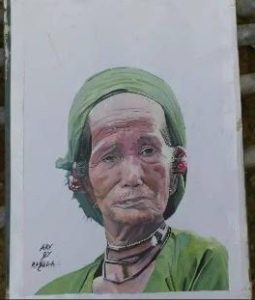 From an early age—around five—drawing and painting emerged as Rabuga’s most instinctive mode of expression. What began as childhood curiosity gradually assumed the contours of vocation. His first painting, a portrait of his Songsarek grandmother in traditional attire, marked an artistic and cultural awakening. The fulfilment it brought was not merely aesthetic; it was civilisational. In capturing her likeness, he preserved a fragment of collective memory. That moment became the genesis of a lifelong journey.
Family, Adversity, and Moral Formation :
Rabuga Achik Artist’s early life was shaped by adversity. A serious childhood illness necessitated surgery and resulted in the loss of an academic year. Subsequent struggles in school exposed him to social judgement and reductive labelling, experiences that eroded confidence and self-worth. Yet, against this current of doubt, his family remained steadfast.
His father’s unwavering faith proved decisive. Rather than allowing discouragement to define him, Rabuga was urged to recognise and cultivate his innate talent. Art thus evolved into more than creative expression; it became a medium of psychological resilience and self-reclamation.
The family lived under conditions of economic precarity. Although his father was an artist, the absence of institutional support forced him to set art aside temporarily and work as a bus driver to sustain the household. A gradual shift occurred when avenues for traditional art opened during the tenure of Mukul Sangma, enabling artists to reclaim cultural labour as livelihood. Observing his father’s return to art after years of sacrifice deeply shaped Rabuga’s understanding of endurance, delayed recognition, and faith in creative labour.
Education and the Ethics of Self-Teaching :
Rabuga Achik Artist’s educational trajectory was discontinuous yet formative. He began at Emmanuel School, where illness impeded academic progress. At Kids Land English School, teachers recognised his artistic aptitude and encouraged its development. Financial constraints later compelled a transition to a government school, where limited resources were offset by personal resolve.
He currently studies at Chiringpara RMSA Secondary School, where institutional encouragement—particularly from school leadership—enabled his participation in art competitions at district and state levels. These opportunities expanded his horizon beyond the village, situating his work within a wider cultural discourse.
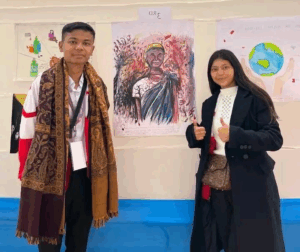 Rabuga has received no formal training in fine art. He is, in the classical sense, autodidactic. His learning has unfolded through observation, repetition, experimentation, and reflective practice, guided indirectly by his father’s lived artistic experience. Formal education, though challenging, instilled habits of discipline, patience, time management, and perseverance—virtues that now underpin his artistic method.
Artistic Practice, Motifs, and Aesthetic Orientation :
At the core of Rabuga Achik Artist’s oeuvre lies a sustained engagement with a singular motif: Songsarek grandmothers. These figures function not merely as subjects but as repositories of memory—embodied archives of wisdom, resilience, and cultural continuity. Wrinkles become historical inscriptions; gazes hold temporal depth. His portraits do not aestheticise age; they dignify it.
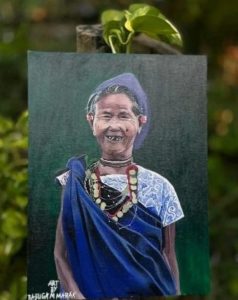 Stylistically, his work occupies a space between emotional realism and ethnographic authenticity. Traditional attire, domestic spaces, and natural surroundings are rendered with attentiveness, situating individual figures within a broader cultural ecology. He primarily employs acrylic pigments, valuing their chromatic intensity and versatility. Working often with modest materials, he demonstrates that artistic integrity derives from intention rather than expense. Fine brushes articulate expression; broader strokes establish atmosphere and spatial context.
Each painting becomes an ethical act—a visual document intended to preserve what oral transmission alone may not sustain.
Recognition Without Display :
Encouraged by teachers, Rabuga Achik Artist participated in district-level competitions, securing first prizes on multiple occasions. His later participation in Shillong brought his work to a more diverse audience, earning appreciation across communities. Though he received third prize, the experience itself proved affirming.
These achievements were shaped by constraint as much as opportunity. Periods of parental illness, financial scarcity, and lack of materials tested his resolve. Government support enabled participation, but it was his cultural commitment that sustained the practice.
Sources of Inspiration :
Rabuga Achik Artist’s primary source of inspiration remains his father—mentor, exemplar, and ethical compass. His quiet discipline and humility continue to inform Rabuga’s artistic temperament.
Another formative influence came from the Indian film Taare Zameen Par, whose narrative of a misunderstood child discovering selfhood through art resonated deeply with his own experience. The film reaffirmed a principle central to his life: creativity constitutes a distinct intelligence, irreducible to academic metrics.
Nature, memory, emotion, and cultural belonging converge in his work, but his guiding principle remains consistent—preservation over popularity, depth over immediacy.
 Art as Narrative and Cultural Archive :
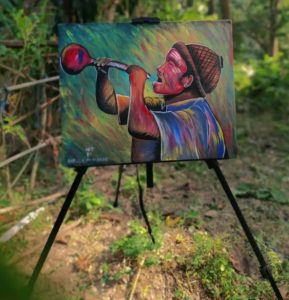
For Rabuga Achik Artist, painting is a narrative act. Each canvas is shaped by recollection—stories heard in childhood, observations of daily life, and the silent dignity of elders. Narrative, in this sense, is not illustrative but mnemonic; it anchors individual images within a continuum of communal experience.
He regards art as a potent medium of cultural preservation. Where written histories are sparse and oral traditions vulnerable, visual art becomes an enduring archive. His paintings allow elders to recognise themselves with dignity and enable younger generations to encounter their heritage with immediacy.
A Living Continuum :
What began as a child’s drawing has matured into a lifelong vocation grounded in responsibility. Through discipline, resilience, and cultural fidelity, Rabuga Achik Artist continues to honour Garo culture and Songsarek tradition—particularly the women whose lives have sustained it.
Each brushstroke becomes an act of remembrance; each portrait, a quiet affirmation that identity endures.
“Painting to keep
our Songsarek
heritage alive for future generations.”
Memory Against Velocity: A Quiet Aesthetic Resistance :
We inhabit an age defined by acceleration—where attention fragments and meaning is compressed into the instant. Against this backdrop, Rabuga Achik Artist’s practice constitutes a form of aesthetic resistance. He chooses duration over speed, contemplation over consumption.
An A’chik proverb offers guidance:
“Mikrakni mikrak, a·songni a·song.”
Walk carefully on a path meant for patience.
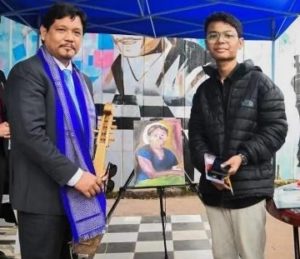 A school-going youth from Betasing, Meghalaya, Rabuga works against the logic of haste. His paintings are accretive processes—weeks of layering, erasure, pause, and return—until memory itself appears to surface through pigment.
Inherited Silence, Articulated :
Rabuga’s art is neither ornamental nor derivative; it is intergenerational. It emerges from Songsarek cosmology, where spirit inhabits forests, ancestry resides within households, and continuity is sustained through practice.
Another proverb reminds us:
“Chra·gipa a·bacheng, skanggipa a·song.”
The past tutors the future.
In portraying elders—often women unnamed in formal history—his canvases become sites of transmission. Age is not marginalised but central; experience is not erased but inscribed.
Tradition in Motion :
Rooted in tradition yet free of nostalgia, Rabuga understands that memory survives only when it moves.
“Golpo dong·gipa, riting re·a.”
A story that travels keeps breathing.
Through Instagram, Facebook, and his YouTube channel—RABUGA ACHIK ARTIST—his work travels beyond geography while retaining its ethical centre: slowness, care, and continuity. He shares not only finished paintings but the process itself—asserting time as an artistic value.
The Grammar of Endurance :
Much of Rabuga’s work centres on women—the custodians of Songsarek continuity.
“Me·chikni mikrak, nokni a·song.”
A woman’s patience holds the house together.
His portraits do not perform emotion; they hold it. Traditional attire and ornamentation appear not as museum artefacts but as living semiotics of A’chik identity.
 The Reader’s Ethical Encounter :
To encounter Rabuga Achik Artist’s work is not merely to admire but to attend. These paintings are acts of stewardship, shaped by cultural clarity and ethical restraint.
“Nikna gita, nikgipa ong·a.”
One becomes what one truly sees.
What one sees here is patience, continuity, and care—qualities increasingly rare and urgently needed.
Recognition Without Noise :
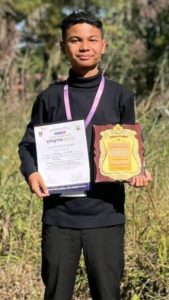
When Rabuga received first prize at a painting competition under the Chief Minister Youth Program at Ampati, the response was marked by restraint rather than display.
“A·songko dakna, mikrakko ra·bo.”
Let the work speak; keep pride low.
More enduring than awards is the manner in which his community receives the work—as shared memory rather than individual possession.
Care as Creative Ethic:
Ultimately, Rabuga Achik Artist’s art is care rendered visible—care for elders whose voices soften with time, for younger generations negotiating distance from ancestral paths, and for a worldview grounded in reciprocity and balance.
“Salangni sal, chanchini chanch.”
Every season has its task; every person, their part.
Even at a young age, Rabuga has discerned his part. His rebellion is quiet, cumulative, and enduring.
In an age of noise, his paintings invite us to slow down, to look closely, and to remember.
Readers may explore his work on Instagram, Facebook, and YouTube under “RABUGA ACHIK ARTIST.” Created with maturity beyond years, these paintings stand as a living Songsarek archive—one remembered face, one preserved in story, one deliberate stroke at a time.

