




Compiled by Aldrin M. Syiem and Hillaryson Syiemlieh
How did the Nongkhlaw Syiemship come to celebrate the death anniversary of King Tirot Sing Syiem every year on March 29, before discovering the actual date of his death, i.e., 17 July 1835? This may be due to the research conducted by historians from different disciplines who, driven by their love for the Khasi Hills, led us all to pay our due respect and celebrate the life of the great patriot on this date.
Ever since India achieved Independence in 1947 from British rule, the Government of India has seen fit to remember and honour Tirot Sing of Nongkhlaw Syiemship, along with other freedom fighters such as U Kiang Nangbah of the Jaintia Hills, and many other national heroes who sacrificed their lives for the country and its beloved citizens.
A quick look into history shows that the memorial foundation stone, in remembrance of the bravery of U Tirot Sing Syiem, was laid on 15 December 1952. It was inaugurated by the then Governor of undivided Assam, Jairamdas Doulatram, in a field in Mairang town, which is now called Madan Mot Tirot. Then, on 29 March 1953, the aforesaid Governor of Assam also came to observe the auspicious day of celebration, along with the Chief of the Nongkhlaw Syiemship at that time, Paiem Kedro Manik Syiem, who belonged to the house of Mawnai and Mawlong Syiem.
To further supplement the origins of this death anniversary celebration, it was first initiated by the people of Mawnai Village under Hima Nongkhlaw, who had not yet converted to Christianity, and the celebration was accompanied by traditional dances. From this initial observance onward, people from other places within the Nongkhlaw Syiemship would come together every year to pay respect to Tirot Sing Syiem on 28 and 29 March.
Besides the traditional dances, there was also a public procession on 4 April 1986 to commemorate the day the great leader declared war against the British forces. This has been inscribed on the memorial tribute of U Tirot Sing Syiem at the mentioned site in Mairang town.
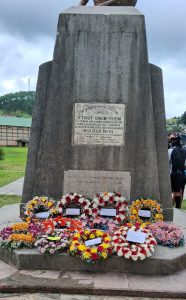 This piece of land was bought by the Nongkhlaw Syiemship not long ago, and the Hima administrative office was built on it, along with the Dorbar (council) house of Hima Nongkhlaw, adjacent to the place where the monument stands. According to legend, the wooden nails, timber used for construction, and the stone pillar called Maw Shankhrum (foundation pillar) belonging to the original house of U Tirot Sing Syiem were buried beneath the foundation of the present memorial monument. Therefore, people of his native kingdom still come every year to place flowers on his monument as a symbolic tribute to his ultimate struggle and sacrifice.
These materials were all brought from Nongkhlaw Village, the traditional capital of Hima Nongkhlaw, where its origins began with the first native king who was consecrated. The religious ceremony of Tang Jait Syiem, conducted by the five ruling Lyngdoh clans, was held at Mawthangsyiar Village for U Shajer, who had been exiled by the royal family of Hima Sutnga in the Jaintia Hills. He ventured into this region with his sister, Ka Shaphlong, where there was no ruling chief except the Lyngdoh clan leadership. Thus, he became the first chieftain of Hima Nongkhlaw Syiemship, and his sister became the first Syiemsad of Hima Nongkhlaw. As recorded by authors from Ri Khasi and the Jaintia Hills, Shajer, after being consecrated to power, even fought a war against Don Ahom to take possession of Borduar Village in present-day Assam, annexing it to Hima Nongkhlaw.
The question now is: why, in the past, was the day of remembrance of his passing observed on 29 March every year? Perhaps there had been a misunderstanding because, on 29 March 1834, an agreement was made between U Rijon Sing and Captain Francis Jenkins, Agent to the Governor of the North-East Frontier, with Agent H. Inglis as witness.
The agreement between Tirot Sing and Mr. David Scott, Agent to the Governor-General, had earlier been renewed in 1826, when Tirot Sing himself was the king. After Tirot Sing was captured by the British Government and deported to Dhaka for imprisonment, 29 March may have been misunderstood as the date of his death.
These words were taken from A Collection of Treaties, Engagements and Sanads Relating to India and Neighbouring Countries (Revised and Continued up to 1929), Vol. XII: Jammu & Kashmir, Sikkim, Assam and Burma, compiled by C. U. Aitchison, Assam No. XXII, 1834. The title refers to the Translation of the Articles of an Agreement furnished to the Governor-General’s Agent, North-East Frontier, by Rujjum Sing, Rajah, on his accession to the Raj of Nungklow, on 29 March 1834.
The written agreement of Rujjum Sing (Rijon Sing), resident of Nongklow (Nongkhlaw), was executed to the following effect: the Government has appointed me to the Raj of the late Teerut Sing on 29 March 1834. It may be that this title was later misinterpreted during the translation process undertaken in the British administration.
On the 25th anniversary of the Khasi Cultural Society (KCS), held at Polo Ground, there was also a celebration of King Tirot Sing’s 150th death anniversary, which took place on 22 February 1984. This strengthened the belief of many that this was the correct day to commemorate Tirot Sing’s death anniversary, not only in Mairang but also across other districts of the Khasi Hills and Jaintia Hills.
Government offices and educational institutions observe this day by declaring it a holiday as a mark of respect for the great patriot. Yet the question still remains: why is the day of remembrance not celebrated on 17 July, his actual date of death, as officially recorded on the memorial monument in Mairang town and confirmed by historians?
To this day, the Government of Meghalaya is still trying to collect and obtain official records related to the imprisonment of Tirot Sing from 1833 to 1835 in Dhaka, Bangladesh. The people of the State of Meghalaya in general, and the Khasis in particular, express their gratitude to the Government of India for releasing the commemorative stamp of Tirot Sing Syiem in 1988.
A request may also be made to the Government of Meghalaya, through the Department of Arts and Culture, the Meghalaya Heritage Authority, the Khasi Hills Autonomous District Council, and the office of the Syiem of Hima Nongkhlaw, to maintain and preserve the memorial stone in Mairang town, which was erected in 1952 as a historical heritage site inaugurated during the tenure of the Government of undivided Assam. There is also the possibility of establishing a heritage memorial museum in Mairang town, depicting the sequence of life events and struggles of U Tirot Sing Syiem.
The memorial stone serves as a remembrance not only for the present generation but also for future generations of the state, as well as for historians and tourists from outside the state who are interested in knowing and documenting the heroic deeds of this beloved native warrior, who sacrificed his life for the freedom of his people and stood against the colonial imperialism of the British Empire.
(The authors belong to the Syiemlieh Mawnai Mawlong clan of Hima Nongkhlaw and are also descendants of U Tirot Sing Syiem.)

