



By Serene Roy Lakuna & Sulila S. Anar
Seed-ball technology is a cost-effective and environmentally sustainable way of pasture development. Seed Balls support natural farming by minimizing soil disturbance, reducing the need for irrigation, and protecting seeds from predation and harsh environmental conditions. Seed Balls provide quality fodder all year round, increasing livestock nutrition, thereby leading to increased milk and meat production. Seed Balls are labour saving and are best to cover a large area in short time period. Originally popularized by Masanobu Fukuoka, a Japanese Natural Farming Pioneer in the 1970’s especially after the publication of his famous book’ The One-Straw Revolution (1975)’. Later adopted in Africa, India and the US for large scale regeneration.
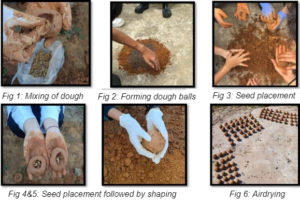 Seed Ball technology is an innovative, low input and environmentally sustainable way to promote pasture development and for regenerating fodder resources. Seed-balls are small balls made of-Seeds of pasture grasses, legumes, or fodder trees along with soil or clay(to protect seeds) and compost or manure(as a nutrient source).This coating shields seeds from birds, rodents, and insects, prevents dehydration,provides initial nutrients and enables seed to germinate only when conditions are favourable, typically after sufficient rainfall (these balls are air-dried and dispersed directly onto the soil surface without tillage).
The different types of Seed Balls are Clay Seedballs, Charcoal dust seed balls (for moisture retention), Bokashi Seed balls ( Which is of fermented nutrient), Aerial seedballs with lightweight binders and coated seed pellets for commercial agriculture.
Selection of Seeds
* Seeds of native species from same climatic conditions are selected for making seed balls. This improves the chances of germination.
* In annual grass or legume species, seed should not be older than one year.
Preparation of Seed Balls
*Collect well drained native soil and sieve it to get clay particles.
* Mix clay, organic fertilizer of your choice and vermiculite in the ratio of 3:2:1.
* Add culture of beneficial microorganisms viz. N fixers, P solubilizers and mobilizers for improving the germination of seeds and growth of seedling even in adverse conditions.
* Add water in the seed ball substrate to prepare dough. If dough is very sticky, cocopeat may be mixed.
* Air dry seed balls for 24-48 hours in a shade before sowing or storing.
Propagation of Seed Balls
* Seed ball propagation must be started during pre-monsoon rainfall or from October – December in winter planting areas.
* The number of seed balls required for propagation depends on the site conditions, size of seed balls and objective of plantation.
Broadcasting /Aerial Throwing
* Aerial throwing of balls is recommended on hillocks or harsh habitats that are inaccessible or fragmented to develop maximum green cover.
* Broadcasting of seed balls can be done by throwing with hands or dropping from helicopter or drones.
* The ploughing or pit digging is not required.
* It covers large area in least time.
Application of Seed Ball in Livestock Farming
1. Seed balls for fodder development in degraded grazing lands- seed balls helps in restoring overgrazed pastures. It reintroduces native fodder grasses. It also improves long term forage availability.(FAO Grassland Index 2019)
2. Fodder seed balls tailored for livestock nutrition- Seed Balls can be customized for different livestock nutrition goals.
3. Silvopasture Development- Silvopasture combines trees, grasses and livestock. The benefit is trees provide shades reducing heat stress in cattle. Availability of fodders even in dry season. This system is particularly useful in hot humid areas where heat stress reduces productivity.(FAO Grassland Index 2020)
4. Erosion control in Livestock Farms- Livestock movement often creates bare patches that lead to soil erosion, water logging and increased incidence of hoof diseases. Seed Balls can quickly re-establish vegetation that stabilizes soil, improves drainage and creates safer walking surfaces for animals. (FAO Grassland Index 2019)
5. Fodder production for zero grazing and stall feeding units- Small holder dairy farmers need consistent fodder for stall-fed cattle. Seed Balls can be used to establish micro pastures around shades, develop mini fodder plots that require low maintenance and grow perennial fodder species with minimal labour. This reduces recurrent feed cost and ensures fresh forage availability.
Advantages of Seed-ball Preparation for Pasture Development
* Cost-effective and labor-saving: Requires minimal inputs and can be easily prepared and applied by farmers or community groups.
* Enhanced soil health: Adds organic matter and beneficial microbes, improving soil fertility.
* Adaptability to challenging conditions: Ideal for dry lands, hilly terrains, and degraded ecosystems.
* Eco-friendly and sustainable: Reduces dependence on heavy machinery and chemical inputs.
* Facilitates large-scale restoration: Easy to broadcast over large or remote areas, even using drones.
* Improved livestock productivity: Ensures year-round fodder availability, supporting animal health and yields.
Impact on Livestock Sector
Seed-ball based pasture development leads to:
a) Improved livestock nutrition.
b) Sustainable fodder resource round the year.
c) Increased milk and meat production.
Conclusion
Seed ball propagation is low-cost method for greening of fragmented and degraded sites. Seed balls are best to cover large area in short time period.
The main purpose of these Seed Balls is to provide quality fodder to the Dairy Cattle as well as to protect the environment.
(The authors are Internee Students (Final Year) B.V.Sc & A.H. College of Veterinary Sciences & Animal Husbandry, Jalukie, Peren, Nagaland)
