




By Col. Arindam Bardhan
In early 2017, I had been to Addis Ababa on my way to India from the Indian UN contingent deployed at Democratic Republic of the Congo (MONUSCO). When booking a local taxi to take me around, the driver was overjoyed to know me as an Indian. He would take me to Gandhi, he insisted. I was puzzled. It seemed a weird idea to be offered to be taken to a dead Indian in a distant African capital! I curiously followed the exuberant Ethiopian to this yet unknown place. On reaching, I was pleasantly surprised to know the place named Gandhi. The street roundel had a huge statue of the Indian legend, the local bank, the hospital, the school all bore the same name. Last month, when our Honourable Prime Minister Shri Narendra Damodar Modi visited the Seychelles, he too bowed to the larger than life size statue of the Indian legend.
The idea of Gandhi has been under attack for the past few years in the current disturbing global scenario of might being the only right. When Russia – Ukraine war flared up in 2022 and continues to this day, or recently when USA attacked Iran in response to Israel-Palestinian conflict in 2023, the world has constantly moved to rearming itself at a rate not seen since the Second World War. New alliances and technological drift towards militarisation through AI, continuously portend display of military might as the new political language for powers coming to age. Coupled with the scourge of non-state actors, regions like Pakistan’s internal protests and counter military reprisals, Afghanistan Pakistan border, or our own state of Manipur seem increasingly drawn into the vortex of unending violence.
Matters took to a heady mixture of social unrest around our neighbourhood with states like Myanmar, Maldives, Sri Lanka, Nepal and recently Bangladesh struck by violent Gen Z protests. Each protest spiralled into retributions and punishments for people caught on opposing sides with differing ideologies or communal identities. India too saw its share of organised violence in West Bengal on the RG Kar Hospital incident or the teacher recruitment scam in 2025. The sense of unrest amongst the youth was palpable due to the uncertainty in the neighbourhood and social media adding fuel to the already vitriolic 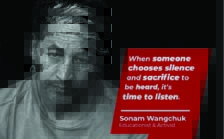 situation around the neighbourhood.
When the NEET fiasco unfolded in the national capital on May 12, 2026, it was linked to the series of failures in the education system straining at the sinews of the exasperation of an already disillusioned youth. It did not help that an indifferent remark by the highest Court of the State labelled unemployed individuals and activists as “cockroaches”. The dam of disillusionment of the youth had reached its peak with reports of NEET paper leaks lighting the tinder.
Sonam Wangchuk was not new to this diffident situation. Being an educationist, he had been closely studying the local problems of the ecological fragile regions of Ladakh, creating many innovative solutions such as Ice Stupa, passive solar heated buildings and SEMCOL alternative school. He was awarded various national and international recognitions for his yeoman service at grass root levels and education. He had raised various core demands for protection of the fragile Himalayan ecosystem and organised protests in 2025, which had turned violent, leaving four dead and many injured. He was held for 170 days in detention under stringent National Security Act in September 2025 to be subsequently released in March 2026. The current student activism was galvanised with his expression of solidarity for student demands through indefinite fast from 28th June 2026. Social media was rife with allegations of the protests’ intent, from foreign hand to a conspiring opposition. The sequence of activity till the Education Minister’s resignation on 25th July 2026 is known to all.
Prime Minister Modi addressed the youth through a personal message on social media on July 24, 2026. The joint government delegation met Sonam Wangchuk at Medanta Hospital on the same day when he finally broke his fast. The Education Minister’s resignation followed soon after. What was evident was the youth across the country had been stirred by the sacrifice and suffering generated by the fasting activist and the accompanying students. All efforts to discredit the movement fell flat when the MEA acknowledged no foreign involvement in the pan India student movement. Amidst the daily contest of narratives and counter narratives, in spite of all sorts of physical and virtual provocations, what was steadfast was the non-violent nature of the protests across the country. A new generation Satyagrahi in the shape of Sonam Wangchuk rekindled hope amongst countless despondent youth, giving them belief in their commitment and capability. When the world was hurtling towards violent Armageddon, the national stir was channelized towards peace activism through an act reminiscent of our freedom struggle. Citizens who were critical of the power of self-sacrifice in a militaristic age and sceptical of a lone man in a loin cloth moving the British Empire, were proven the collective might of individual self-sacrifice for nation building by the individual acts of the activist and his followers.
By the time the dust settles and the Parliament ratifies new laws to curb leaks as committed by the Prime Minister, one may forget the chronology of events leading to the unrest and its consequent actions. What will be remembered, however is that the timeless Indian values of brotherhood and self-sacrifice still wield the capability to steer a restive society to political solutions. Satyagraha as a tool of conflict resolution was vindicated by the Gandhian approach through Sonam Wangchuk’s peace activism. Through display of sacrifice over destruction, committing faith on the youth to steer the peaceful protests, changing the heart of an indifferent state, all displayed the collective power of the human conscience. The individual soul proved superior to the state machinery, galvanising millions in its stride. It is hoped that this brand of activism finds more and more resonance in the Indian community as well as the regional neighbourhood and global society in the quest for a more peaceful and equitable society for our future generations.
(Colonel Arindam Bardhan, SM, is an alumnus of the St Edmunds College, Shillong. He is serving with the Indian Army currently and posted to the 58 Gorkha Training Centre, Shillong. Views are personal).

